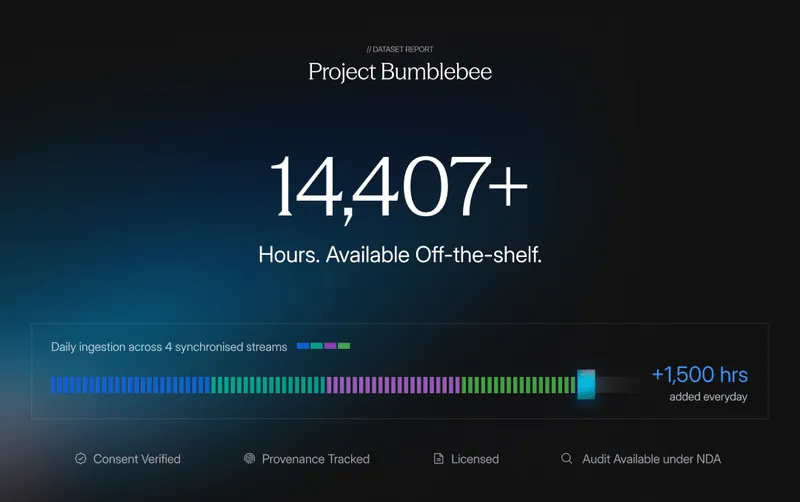
This report of our egocentric video corpus focuses on the properties that help characterize a corpus for embodied learning.
All Research
Introducing the Bumblebee Dataset Report
This report of our egocentric video corpus focuses on the properties that help characterize a corpus for embodied learning.
More Research
Introducing VoxClash TTS 2.0
Cartesia Sonic 3.6 has the highest Elo on six of nine languages, and ElevenLabs v4 and Gemini 3.1 Flash TTS lead the rest.
.png)
Introducing CaptionBench: A Stalemate on the Leaderboard Masks Distinct Failure Modes
In this video captioning benchmark, we evaluated six video captioning models by having trained reviewers rewrite and grade every caption against the footage, then checked what those corrections revealed against what the leaderboard scores showed.
.png)
1
Models Evaluated
Seedream 4.0, Higgsfield Soul, GPT Image 1, Flux.1 Kontext and Nano Banana Pro.
2
Task Diversity
Multi-complexity tasks across image generation (novel/knowledge-based) and image editing (with/without preservation) domain.
3
Prompt Design
40 novel prompts constructed from a 5-dimension taxonomy (Use Case × Content Type × Style × Conversation Type × Composition) ensuring diverse coverage.
4
Rubric Dimensions
- Visual Aesthetics (Simplicity, Diversity, Colorfulness, Craftsmanship)
- Quality Adherence (Object & Layout Fidelity, Attribute Fidelity, Edit Precision, Context Preservation, Seamlessness, Text Legibility, Knowledge Grounding)
- Creativity & Novelty
- Fairness & Representation
5
Scoring & Rating
Scored model performance on 4-point Likert scale (1=lowest, 4=highest) and implemented win-rate matrix over N=40 head-to-head comparisons.
6
Quality Control
- Gold samples injected mid-evaluations for drift monitoring (3 independent annotations per task).
- QC adjudication layer for disagreements (~12% of datapoints).
Note:
- This is NOT a definitive ranking. It's a structured snapshot under specific rubrics and prompts.
- Scores do NOT predict performance on prompts outside the taxonomy's covered combinations.
- Results do NOT account for inference cost, latency, API availability, or pricing — only output quality.
