VoxClash S2S ranks speech-to-speech models on live phone-support calls, grading what each model did and what it told the caller. It brings four improvements over most public voice-agent benchmarks, and no other benchmark we reviewed in November 2026 has all four:
- Live human callers: a person is on every call, working from a script. τ-Voice, EVA-Bench and both Cekura suites test against synthetic voices or playback.
- Full end-state grading: code grades the full end state, so a wrong cancellation fails the call even if the right booking follows. Speech Agent Arena checks only the final actions.
- Spoken facts checked in the audio: a judge checks the recorded audio for every fee, date or warning the policy requires. τ-Voice reads the model's own transcript instead, and five of the seven boards don't check at all.
- Human review of every call: a caller who breaks the script records again, and a person reviews every call before it counts. No other board we reviewed has a person check the caller.
The best-known benchmarks each cover part of this job. τ-Voice, the agentic test in the Artificial Analysis Speech-to-Speech Index, grades the end state but simulates the caller and reads the model's own transcript. Speech Agent Arena puts real people on the line but scores the final tool calls and a preference vote, not what the caller was told. None of the boards with live callers checks what the caller was told. VoxClash S2S checks both on every call.
What we found
Finding 1 · Ranking
The model that completes the most tasks ranks fourth
GPT Realtime 2.1 completes 93.6% of its tasks, more than any other model, but it fails the spoken check on more of those calls than the other top models, so it ranks fourth on Success. Grok Voice 3.0 ranks third on task completion and first on Success. The four Success intervals overlap, so this order is not settled.
Finding 2 · Spoken check
95 calls did the job but didn’t tell the caller
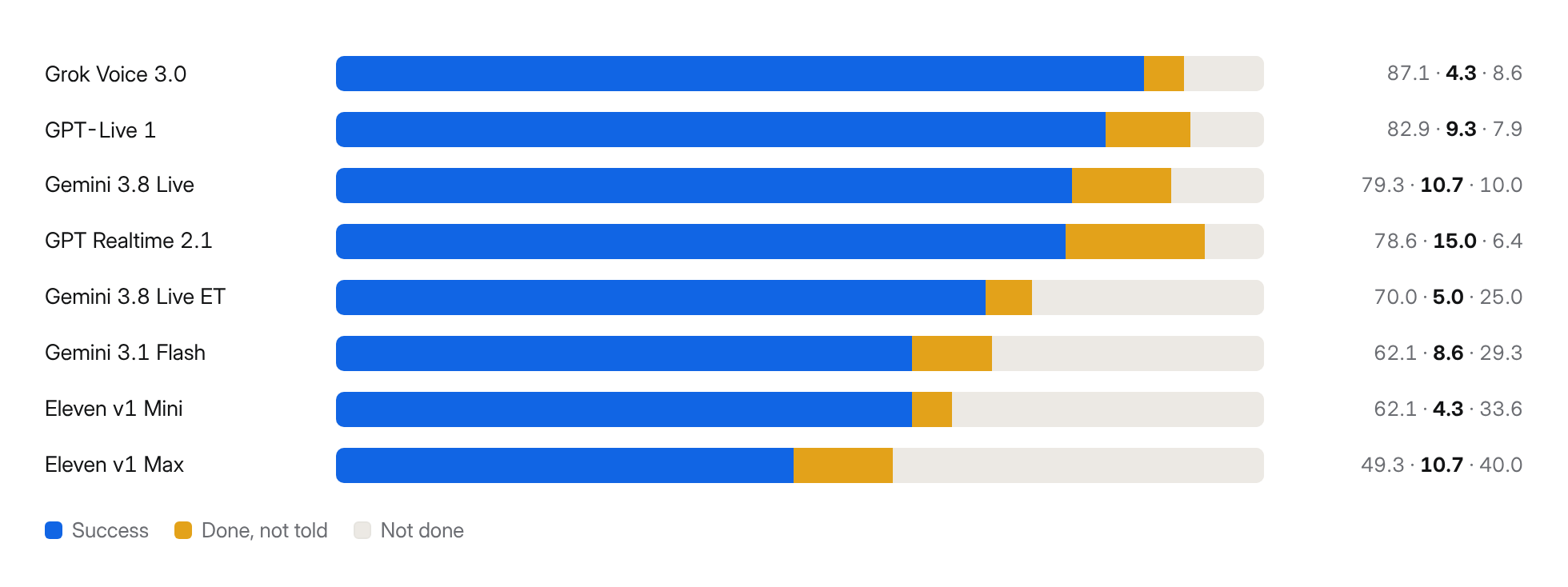
In 95 of the 895 calls that completed the task, the caller did not hear a fee, date or warning the policy required. That's 10.6% of completed calls, and it varies about fourfold by model.
Finding 3 · Extended thinking
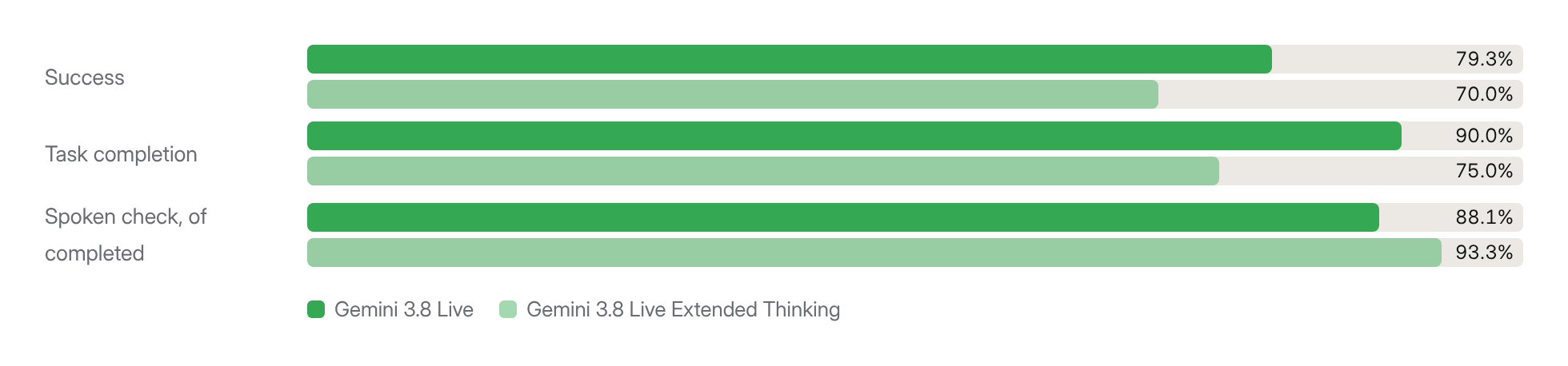
Extended thinking lowered Gemini 3.8 Live’s Success by 9.3 points
With extended thinking on, Gemini 3.8 Live completed 105 tasks instead of 126. The calls it did complete passed the spoken check more often, 93.3% against 88.1%, but not by enough to make up the lost tasks.
The leaderboard
Eight models at provider defaults, 140 scored calls each, ranked by Success. Results as of 20 November 2026.

How it compares
Eight questions, asked of VoxClash S2S and seven public voice-agent benchmarks as they stood in November 2026. VoxClash S2S is the only one with a yes in every row.

Live human callers
Every call has a real person on the line, working from a caller card: "Do this" sets the goal, and "Give only when asked" lists details, such as a PNR or a date of birth, that the caller hands over only on request. Scripted cards still leave the hard parts to the model, because many have the caller correct a detail mid-call, hold back a required fact, or ask for two or three things at once.
Each scenario is recorded by two callers, one man and one woman, and a caller records a given scenario on only one model, so nobody practises a card before the next model hears it. τ-Voice simulates its callers instead, with text-to-speech personas, background noise, accents and telephone compression, which are conditions we do not test.
Spoken facts graded from the audio
A support call has two results: what changed in the system, and what the caller was told. A model can get one right and the other wrong, so every call goes through two checks.
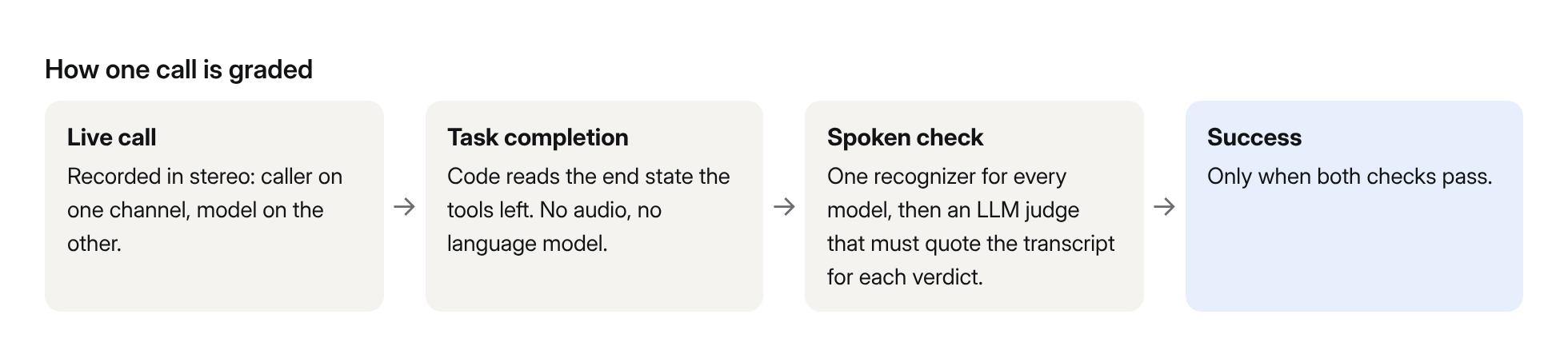
Airline scenario A3 shows why the two come apart. The caller wants to cancel a Saver flight only if the full fare comes back. Policy refunds the taxes alone, so the right agent keeps the booking and still tells the caller the refund would be ₹780.
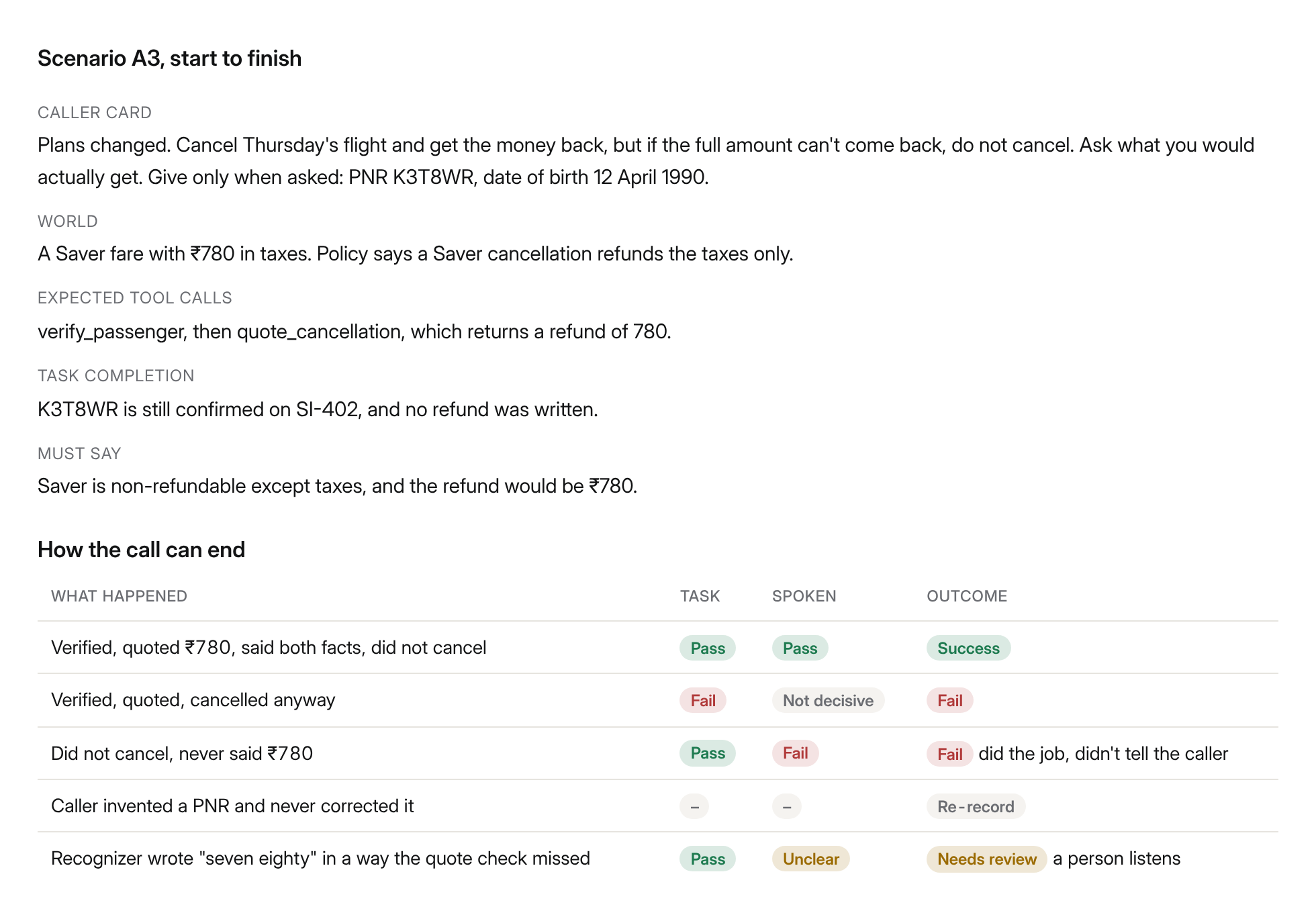
Other boards check the first result more closely than the second. Speech Agent Arena's own launch post noted that "some conversations can sound as though the requested action was completed even when the required final tool call was unsuccessful." We measure the mirror image: the tool call was right and the caller was not told.
Caller mistakes are re-recorded, and a person checks every call
A benchmark with live callers is only as fair as its handling of caller mistakes. A wrong date of birth, a hang-up mid-question or an invented constraint should never count against the model, so a call where the caller broke the card is recorded again.

Hiding the model's result stops a caller from retrying a failed call until it gets a lucky pass. Other boards filter caller mistakes by machine: Speech Agent Arena with an LLM judge, τ-Voice and EVA-Bench by re-running conversations where the simulated caller drifts. VoxClash S2S puts a person at the end of that process. Some calls needed another take, and the board still has all 1,120.
A complete grid with live callers
All 8 models take all 70 scenarios with both callers, so every rate on the board has the same denominator, 140 calls. The scenarios cover ten Indian consumer support lines (food, clinic, power, bank, store, pharmacy, telecom, airline, hotel, insurance), seven each, with 117 tools and no FAQ-only chats. Fixed suites such as τ-Voice and EVA-Bench also run every task on every model, but with simulated callers; live-caller arenas sample instead.
Results
Task completion hides where the top models fail
On task completion the top four sit within 3.6 points. Add the spoken check and Success spreads over 8.5 points, and the order changes.
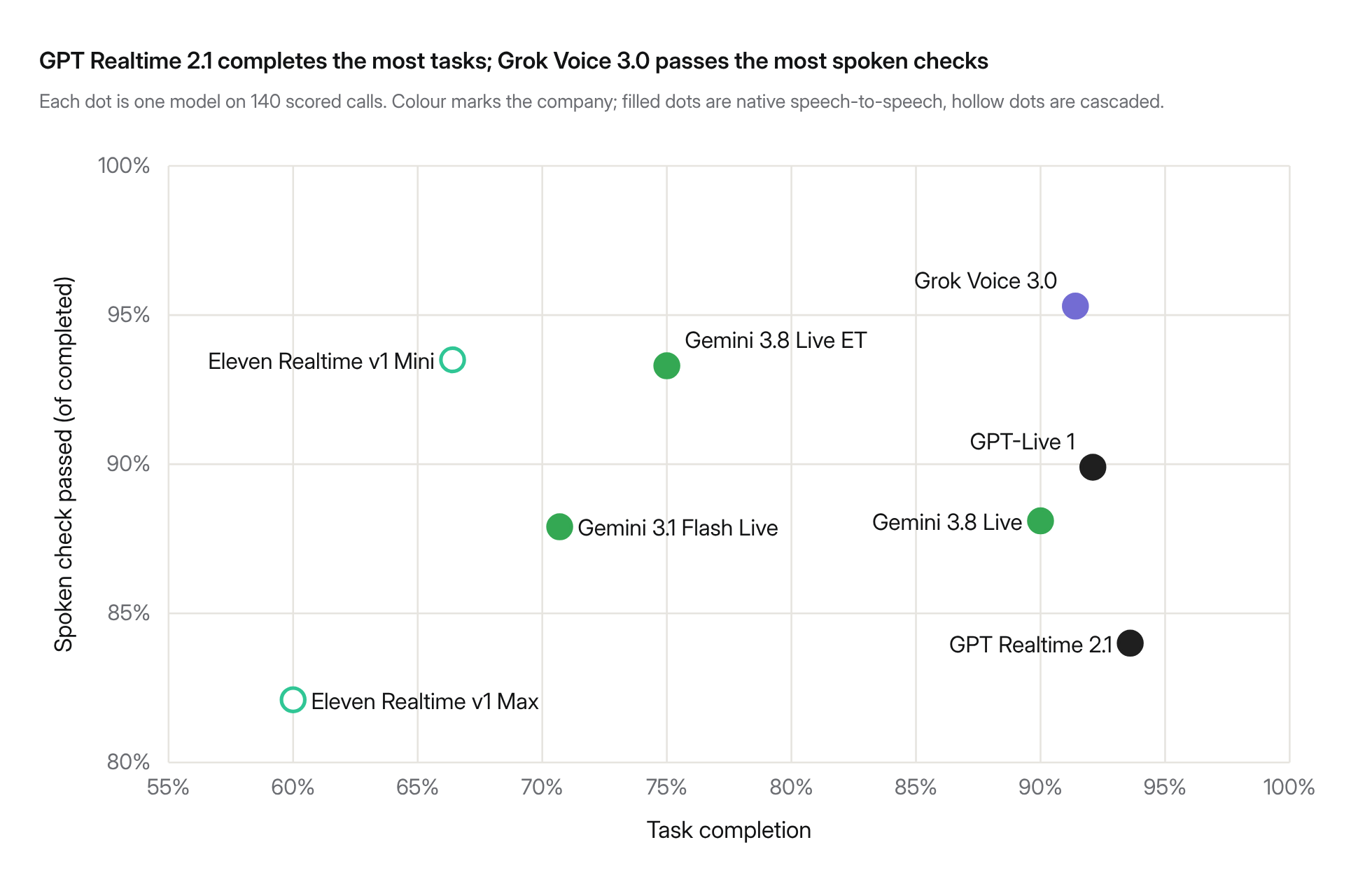
All six native models score at or above both cascaded ones, but the two cascaded models fail in different places: Eleven Realtime v1 Mini passes the spoken check on 93.5% of its completed calls and loses on task completion, while Eleven Realtime v1 Max is lowest on both.
Where the calls went
Every model's 140 calls, split three ways. The amber band is the one the board exists to find: the job was done and the caller still was not told.
Extra thinking lowered Success
Same model, with and without the extra thinking pass (thinking_level=high, the same choice Artificial Analysis made).
Where calls fail depends on the support line
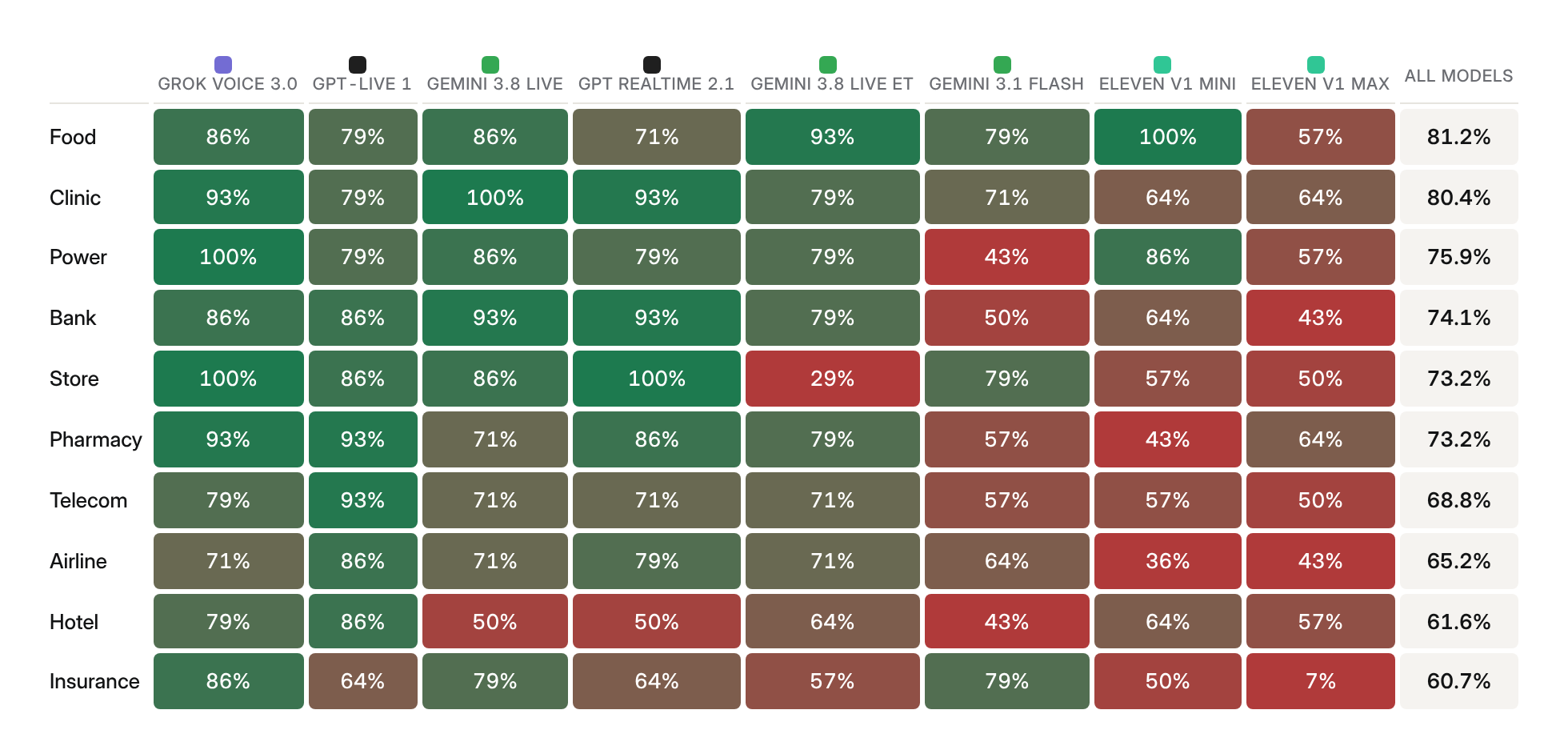
Success on each line, per model. Each cell is 14 calls, so one call moves a cell by 7.1 points; read the rows, not single cells.
Method in brief
- Scenarios: 70 scenarios, 7 per support line. Each card carries two or three of 11 case types, such as a policy refusal, a mid-call correction or a scripted tool failure, mixed so callers can't learn a trick per line. No partial credit.
- Sandbox: follows τ-bench: policy lives in the prompt, not the tools, so a forbidden write still executes and the call fails on its end state. Fresh seed and frozen clock per session.
- Task check: code checks the listed fields, with tolerance where speech makes exact matches unfair: dates as values, money ±1, one slip or sound-alike in a name. Identity must be verified before any protected action.
- Spoken check: ElevenLabs Scribe v2 transcribes every model; provider transcripts are never used. Claude Haiku 5.5 answers narrow pass, fail or unclear questions and must quote the transcript. No politeness, style or speed score. Must-say lines were written with an LLM and checked by people; 9 of 70 scenarios have none.
- Call setup: provider defaults, with the voice, VAD and noise-reduction fields LiveKit injects stripped, and the config sent logged per session. Audio runs browser to LiveKit Cloud to the provider's realtime API, not over the phone network.
- Same for every model: prompt, tools, seed, clock, recording path, recognizer, judge and channel layout.
Every model gets the same system prompt, a shared preamble followed by that line's policy:
You are the phone support agent for {business}. Today is {now}. Follow the policy below exactly. Use tools for every fact about accounts, bookings, prices and availability, never guess or invent values. Before any action that changes something or costs money, state what you will do and the cost, and get a clear yes. If a request is not allowed, say so plainly and offer what is allowed. Never ask for full card numbers, PINs or passwords. Keep replies short and natural for a phone call.
What this board does not measure
- Tuned deployments. Every model runs at provider defaults, which is the product a buyer gets.
- A neutral recognizer for every row. ElevenLabs makes both the recognizer and two of the models under test; quote checks and tool arguments limit that overlap without removing it. The judge can also be wrong, which is why a person reviews every take.
- Other markets. The locale is Indian English and rupees, and our workers run in one cloud region (ap-south-1).
- Latency as a headline number, phone-network codecs, voice cloning, or which voice listeners prefer. Our VoxClash and VoxClash TTS 2.0 boards cover preference.
References
- Yao, Shinn, Razavi, Narasimhan. τ-bench. arxiv.org/abs/2406.12045
- Ray, Dhandhania, Barres, Narasimhan. τ-Voice. arxiv.org/abs/2603.13686
- Artificial Analysis. Speech Agent Arena. artificialanalysis.ai/speech-to-speech/arena/overview
- ServiceNow. EVA-Bench. github.com/ServiceNow/eva
- Voice Arena. Jarvis Bench. voicearena.com/jarvis-bench
- Cekura Bench. github.com/cekura-ai/cekura-bench
- David AI. DIAL. [Link to fill]