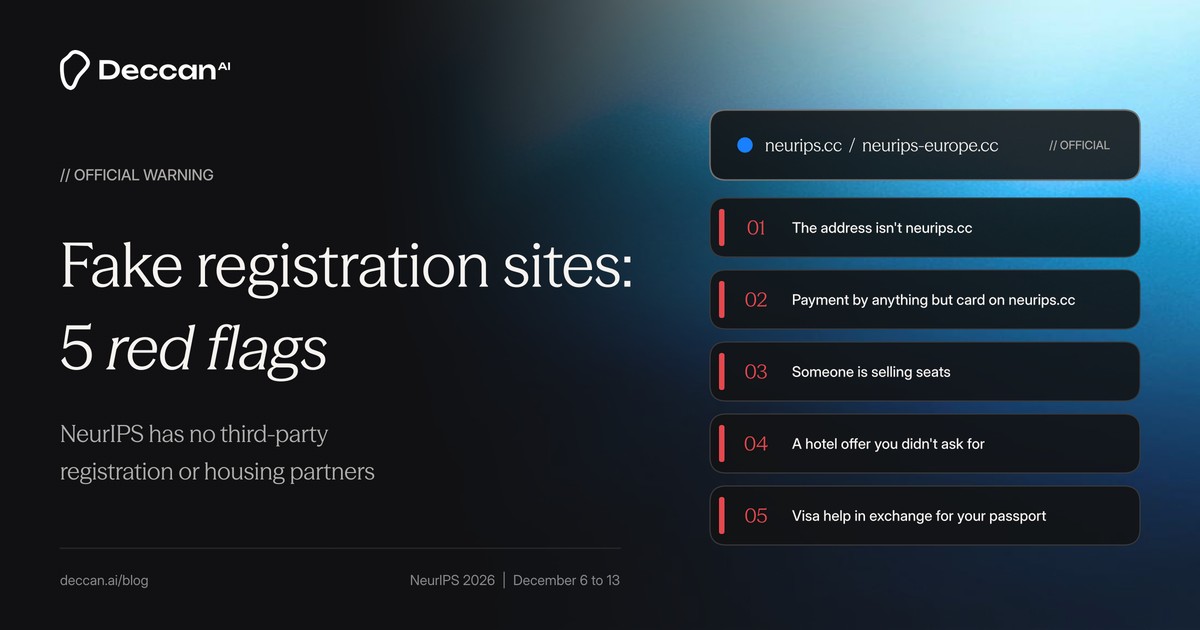
NeurIPS has put a warning at the top of its homepage. Dated August 25, 2026, it says the conference "has no affiliation or partnership with any third-party service that claims to collect registration or housing information." Registration and housing go through the official NeurIPS website and nowhere else.
The timing matters. Early registration closes on October 30, and the Paris satellite has already sold out for everyone except presenting authors, with its waitlist closed. Scarcity is what scammers sell. A researcher who missed out on Paris is exactly the person who will click on an email offering a "guaranteed seat."
NeurIPS isn't alone here. In 2026, the American Society for Reproductive Medicine warned that sites impersonating its registration page "have surfaced this year," and the ECNP congress in Munich warned of agencies selling registrations and hotel rooms by phone under its name. Large conferences attract these operations every year, and NeurIPS, which drew about 26,000 registrants in 2025 and now spans three cities, is a large target.
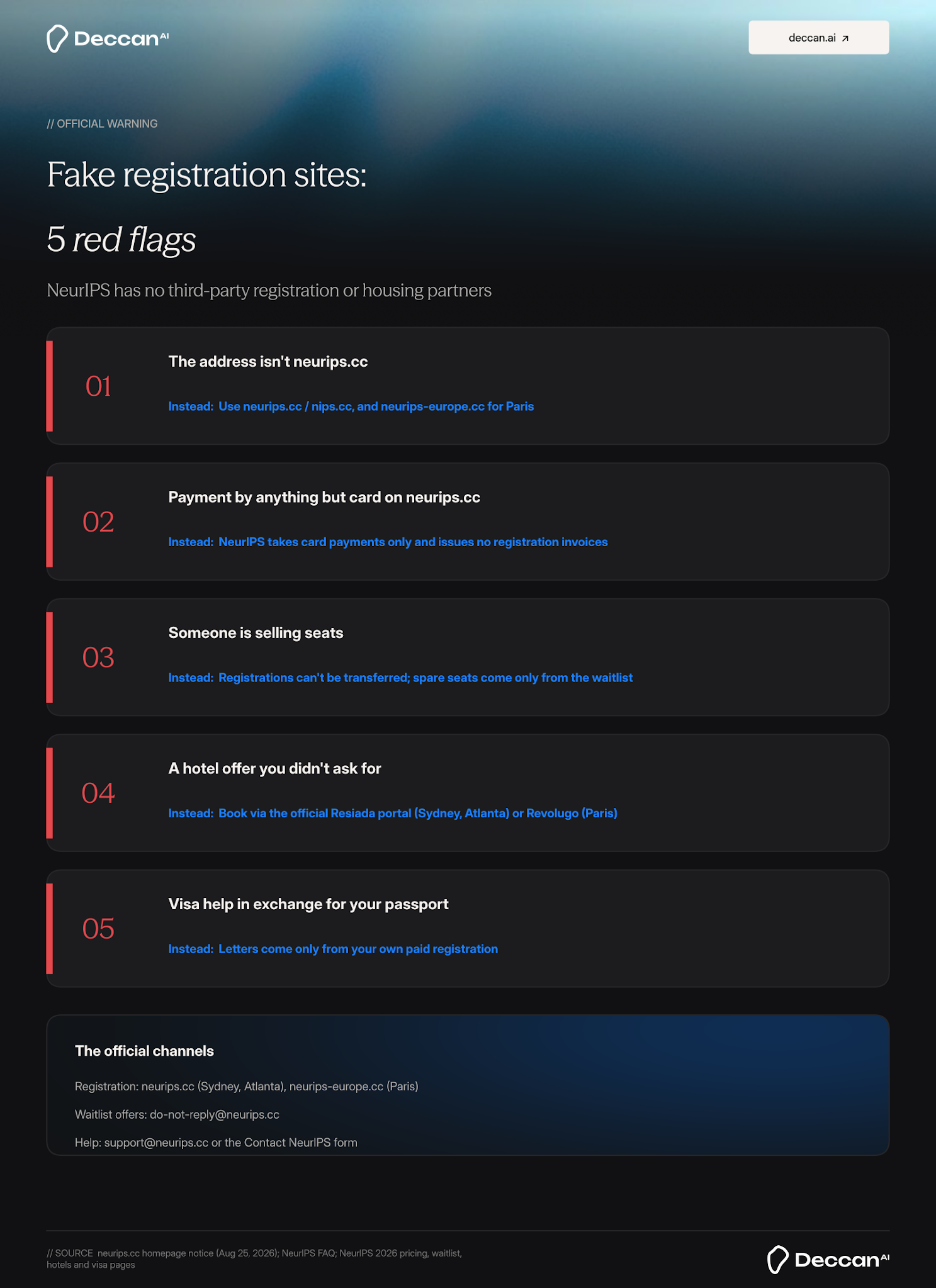
Here are the five red flags that give a fake away, and the short list of official channels to use instead.
The only official channels
Type these addresses yourself or reach them from the neurips.cc homepage. Don't follow links in an email you weren't expecting.
1. The address isn't neurips.cc
Every legitimate NeurIPS page lives on neurips.cc, its older alias nips.cc, or a subdomain of them (blog.neurips.cc, media.neurips.cc). The one exception this year is the Paris satellite at neurips-europe.cc, and the neurips.cc homepage links to it directly.
Fakes rely on near misses: an extra word, a different ending, a year added to the name, or a hyphen in an odd place. Some go further and rename the event. In 2020, a "conference" called ICRA2021 charged US$530 for registration while claiming the initials of IEEE's robotics conference with one word changed. Read the whole address, and if a site calls itself something close to NeurIPS but not quite, close the tab.
2. They want to be paid any way but by card on neurips.cc
NeurIPS's FAQ is plain: "NeurIPS only accepts credit card payments for registrations." It also says the conference does not generate invoices for registrations. You get an emailed receipt after you register.
So a request to pay by bank transfer, wire, cryptocurrency, gift card or "invoice to your institution" is a fake by definition. The same goes for anyone who offers to register you and take payment on your behalf. NeurIPS has said on its X account that it does not use third-party or online agents to support registration or payment.
3. Someone is selling seats NeurIPS says it doesn't have
NeurIPS registrations "can not be transfered or shared." When a site sells out, extra seats come only through the official waitlist. NeurIPS has said it will "exclusively rely on the waiting list to fill these additional spots," and offers arrive by email from do-not-reply@neurips.cc.
That rules out every other source of tickets. A reseller with Paris passes, a colleague-of-a-colleague offering to "transfer" a registration, or a company promising to move you up the waitlist for a fee: none of these can deliver. NeurIPS's waitlist page even asks people not to call or write about their position, so nobody calling you about a waitlist spot is from NeurIPS.
4. A hotel offer arrived before you asked for one
This is the most common version of the scam at big conferences. The events industry calls these operators "housing pirates." They email attendees and exhibitors offering rooms "near the venue" at conference rates, sometimes using the event's logo. Some are overpriced resellers. Some take a deposit and book nothing.
NeurIPS's hotels page tells Sydney and Atlanta attendees to book through the official portal, "not directly with any hotel or third party, which risks losing your rate," and warns against "booking through an unauthorized site." Paris rooms go through Revolugo. If an offer came to you instead of you going to it, treat it as fake until you've found the same rate through the official hotels page.
5. Someone offers visa help in exchange for your passport details
Visa invitation letters for NeurIPS 2026 come from one place: your own paid, in-person registration. Sydney and Atlanta attendees generate the letter inside the registration system. Paris attendees request it while registering. NeurIPS doesn't send letters before you've paid, and it doesn't issue them after the conference closes.
Any third party offering a "faster" letter, visa support packages, or help with your application in return for a scan of your passport is collecting identity documents, not helping you travel. With the October 20 cutoff for visa-refund protection close, these offers will look tempting. Ignore them.
If you think you've been targeted
Stop any payment you can and contact your card issuer. Report the site or email to NeurIPS through support@neurips.cc or the Contact NeurIPS form, and forward the message to your institution's IT or security team, since these campaigns rarely target one person. Then register through neurips.cc as normal. A scam doesn't use up your official place in line, and the refund deadline for real registrations is November 4.
The same red flags apply to AI data vendors
The checks in this article aren't special to conferences. They are the same ones research teams should run on anyone who handles their training data, evaluation sets or expert annotations. In both cases, you're handing money and sensitive material to an organization you can't fully inspect, and the warning signs look alike.
A fake conference copies a real name with one word changed. The fake ICRA's organizer listed degrees from three top universities and thousands of citations that didn't hold up. Vendors can inflate their claims the same way. Ask how a vendor verifies the credentials of its experts and annotators, and ask to see the process, not just the headcount.
A fake site asks for payment outside the normal channel. A vendor that won't put data handling, ownership and deletion terms in a written contract is asking you to pay outside the normal channel too.
A fake waitlist offer promises what the system doesn't allow. A vendor promising expert-level labels at a speed and price no qualified human team could reach is doing the same. Ask for their quality-control numbers, how many review passes each item gets, and whether you can audit a sample before you commit.
And a fake visa service wants your passport. Any vendor should explain exactly where your data goes, who can access it and how it's secured before you send a single file.
If you're evaluating Deccan AI, or any other vendor, for model training and evaluation work, those are fair questions to ask in the first call. A trustworthy vendor will have the answers ready, the same way a real conference has one official website and tells you what it is.