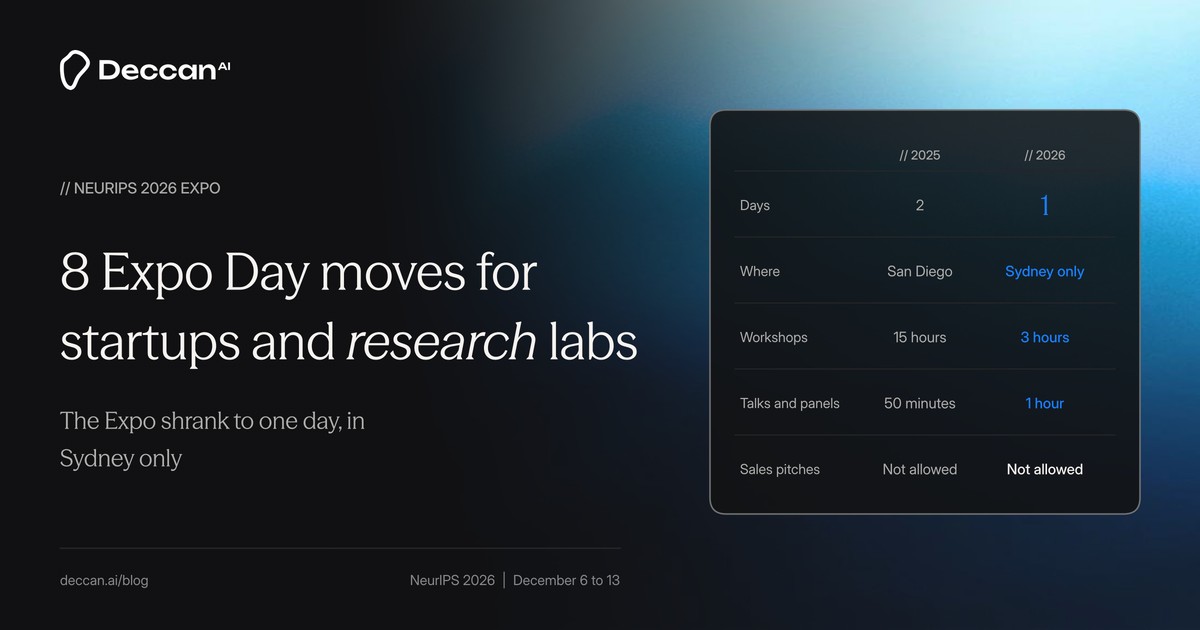
The NeurIPS Expo got shorter this year. In 2025, i t ran for two days in San Diego. In 2026, it runs for one day, Sunday, December 6, and only in Sydney. The official call is direct about it: "There are no expo talks/demos/workshops in Atlanta or Paris."
That changes the math for every company and lab planning around it. Half the days, one city, and a day that falls before the main conference even opens. Expo applications closed on October 9 (Sydney time), and decisions went out in mid-October, so the people with slots now know who they are. Everyone else is deciding whether Expo Day justifies a seat on the flight to Sydney.
Below are eight moves that hold up either way. None of them involve a sales pitch, because the Expo doesn't allow one.
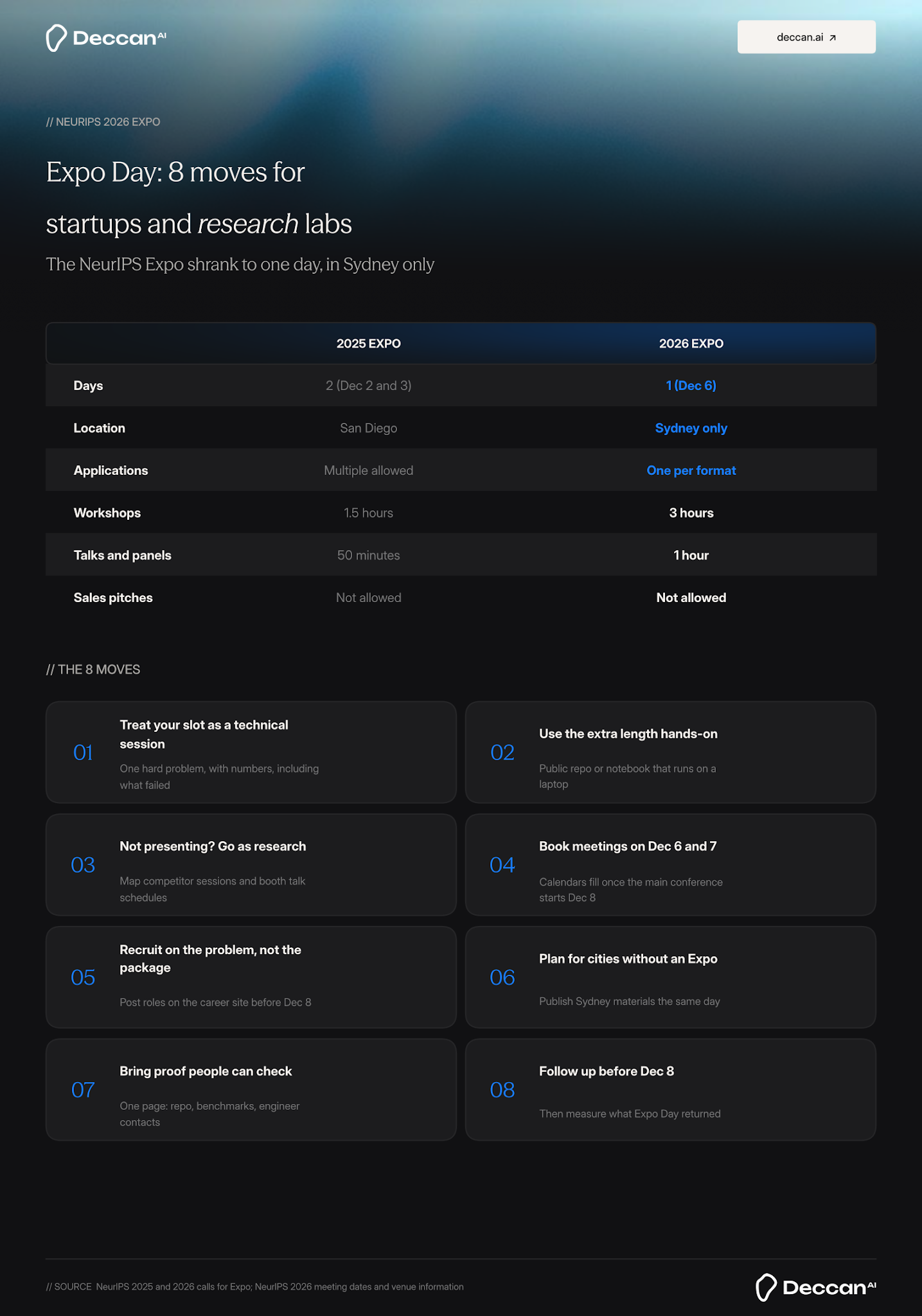
What changed between the 2025 and 2026 Expo
Two shifts matter most. Fewer slots go around, since each exhibitor can now file only one application per format. And the sessions that do run are longer, which rewards material people can work through with you rather than slides they sit through. The 2026 call asks for "technically useful ideas and actionable industry perspective," and says the review team looks for "a diversity of thought and organizations."
1. Treat your slot as a technical session, not a booth extension
If your company got an Expo slot, the review team picked it on technical grounds, and the room will judge it the same way. NeurIPS repeats the rule from 2025 word for word: the Expo "is not an appropriate place for purely sales or marketing content and purposes."
The safest format is one hard problem you actually solved, with the numbers. Say what broke, what you tried that didn't work, and what you measured at the end. A talk about how your team cut evaluation costs on long-context agents, including the run that blew the budget, will fill more seats than a product tour with the same information hidden in it.
2. Use the extra length for something hands-on
A 3-hour workshop is twice as long as last year's hands-on slots. That's enough time for attendees to clone a repo, run a notebook,k and break something. Plan for it. Ship a public repo or notebook that works on a laptop without your paid product, test it on bad conference Wi-Fi, and bring a fallback for people who can't install anything.
Demos now get 2 hours. Use that time to let people try the system with their own inputs, which is the kind of demo a NeurIPS audience trusts most.
3. If you're not presenting, go to the Expo as research
Most startups and almost every academic lab will not have a slot, since only Diamond and Platinum exhibitors can apply. Expo Day is still one of the cheapest days of competitive and technical intelligence you will get all year.
Read the Expo program the week before and mark every session from companies in your space. Go to the ones that show methods, evaluation setups,ps or infrastructure choices you would otherwise have to guess at. Research labs should look for something else: industry teams presenting problems that match their own work, which is where data, compute, or co-authorship partnerships start.
Also check the booths, not just the stages. Lucy Vost's first-timer guide on the Oxford Protein Informatics Group blog points out that larger booths often run their own talk schedules that never appear in the main program.
4. Book your meetings around December 6 and 7
Expo Day is the only event on December 6 in Sydney. Tutorials and the opening reception follow on December 7, and the main conference doesn't start until December 8. That likely makes the first two days the least crowded days of the week.
Use them. Set candidate interviews, partner meetings, and lab visits for the evening of December 6 or the gaps around December 7 tutorials. By December 8, everyone you want to talk to will be booked into poster sessions and orals, and their time gets far harder to get.
5. Recruit on the problem, not the package
NeurIPS has been a hiring event for years. Fortune's 2023 report described big tech firms, funded startups, Wall Street trading firms, and Chinese tech companies all sending recruiters, with Semafor's Louise Matsakis calling it "the hottest event for recruiting AI talent." The same piece noted OpenAI pay packages reported at around $10 million.
A startup can't win that auction. It can win on specificity. Researchers at NeurIPS respond to a clear, unsolved problem, a dataset nobody else has, or the chance to own a whole system. Put that in every role you post. Post roles on the NeurIPS career site before it stops taking applications on December 8. In 2025, Diamond and Platinum exhibitors could post six roles free, and other postings cost $100 each, so check the 2026 terms in your sponsor portal.
Startups have also used evening events to get noticed. Fortune mentioned Perplexity and CentML hosting happy hours in 2023. If you host one, give it a technical hook, like a short talk or open questions on a problem you're hiring for, so the people who show up are the ones you want.
6. Plan for the cities without an Expo
If your team, your customers, or the people you want to hire are in Atlanta or Paris, the Expo simply isn't there. Both satellites do have exhibit halls: Atlanta's runs December 9 to 12 and Paris's December 9 to 11. A booth there gets you in front of attendees, but without a stage.
Two fixes help. First, publish everything from your Sydney session (slides, repo, notebook, results) on December 6 so people in the other cities can use it the same week. Second, if you want a booth anywhere, the sponsor application deadline is November 3 (Anywhere on Earth), with payment due by November 7.
7. Bring proof people can check later
Researchers tend to remember the artifacts they can open again, not the slide deck. Before you fly, put together a single page with your repo, paper links, a short benchmark table, and contact details for the engineers who did the work. Put a QR code to it on your badge, your booth, and your last slide.
This matters more in 2026 than before. The audience is split across three continents, and a link that works outside the room travels further than anything said in it.
8. Follow up before the main conference starts
Write down every useful conversation the same day, with one next step for each: a call, a repo to share, an intro to a colleague in Atlanta or Paris. Send the follow-ups on December 7, before the main conference begins and inboxes fill.
Then measure. Count the meetings booked, the people who ran your code and the candidates who applied, and compare them against what Expo Day cost. One day is a small sample, but it's enough to decide whether next year's budget belongs in the Expo, a booth, a workshop sponsorship,p or none of them.
The short version
The 2026 Expo gives you less time in one city, and it still rejects anything that looks like marketing. For startups and labs, that's an advantage. The organizations that win on December 6 will be the ones that bring real technical work, give people something to run, and treat the conversations as the start of a research relationship rather than a lead list.