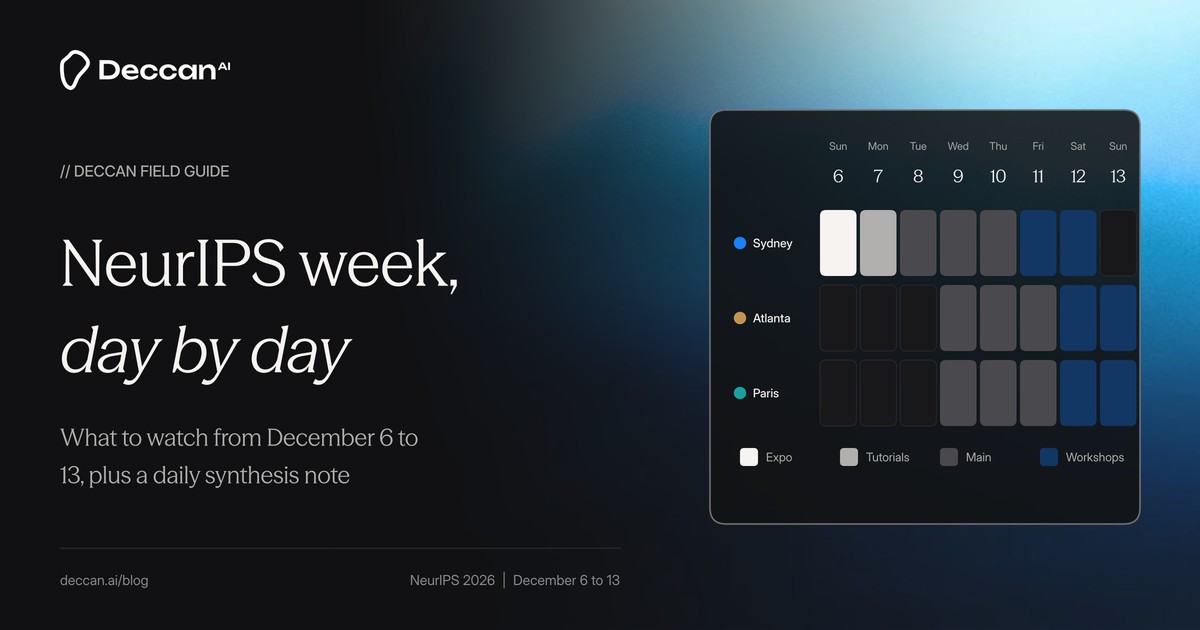
NeurIPS 2026 runs for eight days across three cities. Sydney opens first on December 6, Atlanta and Paris join on December 9, and the last workshops close in Atlanta and Paris on December 13. No single person will see all of it, and most teams will be split across at least two time zones.
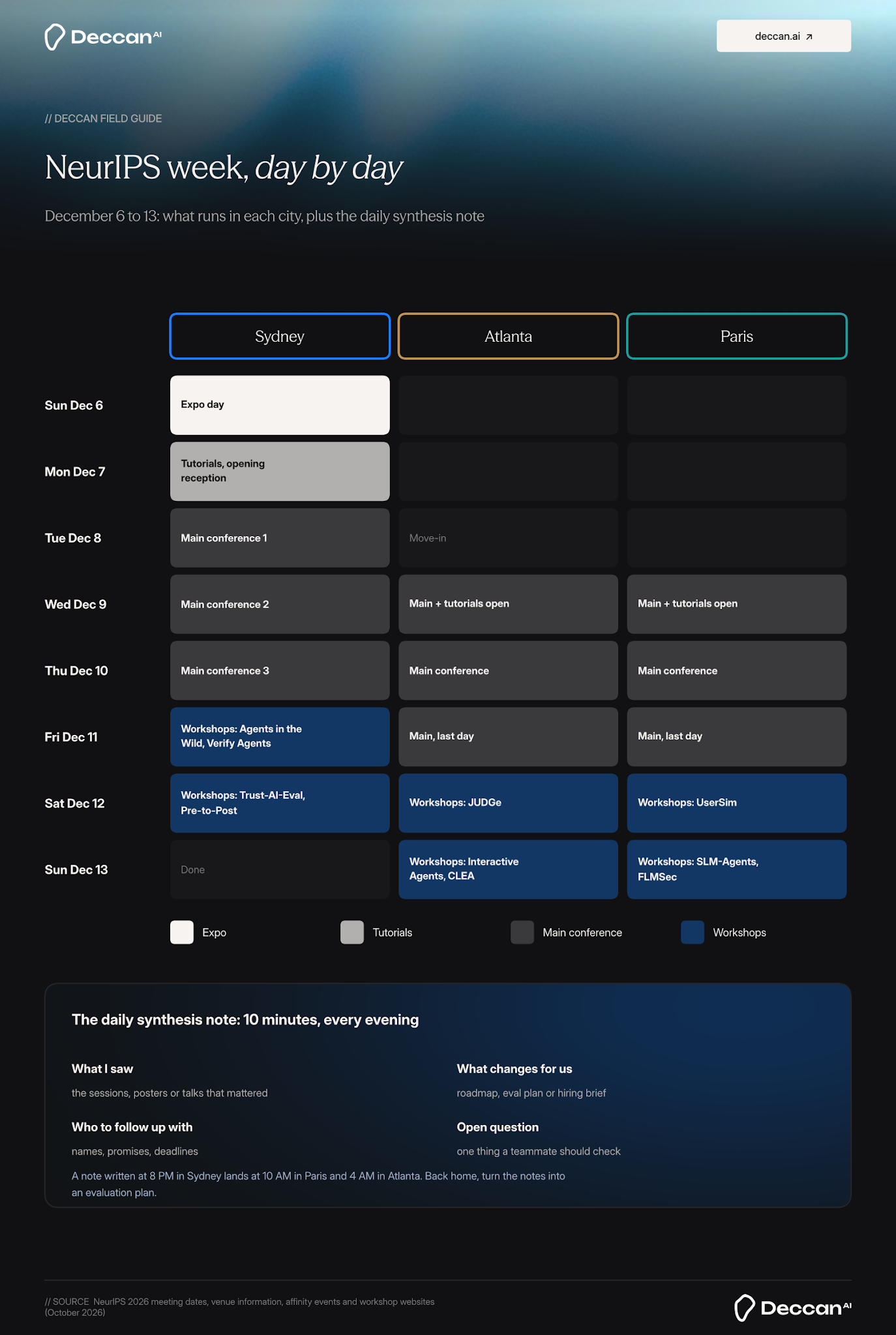
This guide is built to be used during the week, not just before it. For each day, it covers what's happening in each city, what to watch, one survival tip, and a prompt for the short note we recommend writing every evening. Each day also ends with a "back at base" line: the evaluation question that day's sessions should raise for your team once you're home.
All dates are local to each city. When it's Sunday morning in Sydney, it's still Saturday afternoon in Atlanta.
This is a living guide. Final schedules lock on December 2, and we'll update it with session times and any changes after that.
The week at a glance
Before you fly
Most of what makes NeurIPS week work happens before it starts. Lucy Vost's first-timer guide on the Oxford Protein Informatics Group blog has the most practical advice we've seen, and the industry checklist below builds on it.
- Build your poster list in advance. At a conference this size, wandering the poster hall doesn't work. Vost also points out that related papers can sit in different sections, one grouped by field and another by method, so search both.
- Post your open roles on the NeurIPS career site. It stops taking applications on December 8.
- Register interest in company events now. Many private events are announced only to people who fill in a form, and some forms ask for a CV.
- Update your CV, or your team's one-page summary, before you leave.
- Learn the conference app. Schedules, rooms and last-minute changes all go through it.
- Agree on a conference buddy. Vost recommends this for meals and for getting home safely after evening events.
- Book hotels only through the official NeurIPS hotel pages, and generate visa letters only inside your NeurIPS registration.
- Decide who is going where. Presenting authors are locked to their assigned city.
The daily synthesis note
The most useful habit for a team at NeurIPS takes ten minutes a day. Each person writes a short note every evening with four parts:
- What I saw: the two or three sessions, posters or conversations that mattered.
- What changes for us: anything that should change a roadmap, an eval plan or a hiring brief.
- Who to follow up with: names, what was promised, and by when.
- Open question: one thing you couldn't answer and want someone else on the team to check.
Put all the notes in one shared document. The time zones work in your favor here. A note written at 8 PM in Sydney lands at 10 AM in Paris and 4 AM in Atlanta, so colleagues in the other cities wake up to it. By December 13 you'll have a running record of the week that nobody has to reconstruct from memory.
Three threads to follow all week
Some themes run across every day and every city. These are the ones we'd track in the synthesis notes.
Evaluation has become a research subject in its own right. NeurIPS renamed its Datasets and Benchmarks track to Evaluations and Datasets this year, arguing that "evaluation itself becomes an object of scientific study." Expect a lot of work that questions benchmarks rather than topping them.
Agents are everywhere. By our count, 23 of the 102 workshop titles mention agents, and the agent safety and reliability workshops have some of the strongest speaker lists of the week.
Post-training and smaller models keep gaining ground. Workshops on the pre-training to post-training transition, post-training in changing environments, and small language models for agents all run during the final weekend.
Sunday, December 6: Sydney opens with Expo day
Where: Sydney only. Atlanta and Paris haven't started, and in Atlanta it's still Saturday when Sydney opens.
What to watch: the Expo is the only day of sponsor talks, demos and workshops anywhere at NeurIPS 2026. Talks and panels run an hour, demos two hours and workshops three hours. NeurIPS bars purely sales content, so the sessions tend to show real engineering: how companies run evaluation, serve models and build agent infrastructure. Atlanta and Paris teams can use the day to read whatever the Sydney presenters publish.
Survival tip: check booth schedules as well as the Expo program. Vost notes that larger booths often run their own talks that never appear in the main listing.
Synthesis prompt: which company showed an evaluation or data setup more advanced than yours, and what specifically was different?
Back at base: if the Expo showed you a gap between how others test their models and how you test yours, write down the size of that gap. It's the starting point for planning evaluation capacity in January.
Monday, December 7: Tutorials and the first receptions in Sydney
Where: Sydney. Tutorials run all day, along with the Education track primer for science communicators. Affinity events from GlobalSouthAI, LatinX in AI and Muslims in ML meet in Sydney today. The exhibit hall opens at 11 AM and the opening reception is tonight.
What to watch: Sydney has 12 of the 19 tutorials this year. Pick the ones that teach a method your team will actually try, not just the most famous speakers.
Survival tip: pace yourself. Vost's advice is to skip sessions that aren't relevant or when you're tired, because fewer well-attended sessions beat spreading yourself thin. It's day two of an eight-day week.
Synthesis prompt: which technique from today's tutorials would we try first, and what would it take?
Back at base: adopt a new technique only if you can measure whether it helped. Note what you'd need to evaluate it properly: test sets, human raters, or both.
Tuesday, December 8: Sydney's main conference begins
Where: Sydney. Orals, posters and keynotes start. Women in ML meets in Sydney today. Atlanta exhibitors start moving in tonight.
What to watch: the first poster sessions. This is where your pre-built list pays off. It's also the last day to apply for jobs through the NeurIPS career site, so recruiters should make sure every role is posted and every promising candidate knows where to apply.
Survival tip: follow people on social platforms or exchange details right after you meet them. Vost's advice is to do it on the spot rather than waiting until you get home.
Synthesis prompt: which poster changed how we think about a problem we're working on?
Back at base: list the papers that propose new evaluation methods or datasets in your area. Check whether any of them would change how you validate your own models.
Wednesday, December 9: All three cities are live
Where: everywhere. Sydney runs main conference day two. Atlanta and Paris open with main conference sessions and tutorials. Atlanta's exhibit hall opens at 1 PM with a welcome reception, and Paris opens its hall with a welcome cocktail. Affinity events include Africa in AI (Atlanta only), LatinX in AI and Women in ML in Atlanta, GlobalSouthAI in Paris, and Queer in AI in Sydney.
What to watch: this is the first day all three cities are running main conference sessions, and the first chance to compare what each crowd is talking about. Teams split across cities should hold a short handover call at a time that works for at least two of them.
Survival tip: if you're at a satellite, don't assume the Sydney program applies to you. There's no Expo in Atlanta or Paris, and the tutorial lineups are different.
Synthesis prompt: what's different about the conversations here compared with what our colleagues in the other cities reported?
Back at base: if the same evaluation problem keeps coming up in all three cities, that's a sign it's a field-wide gap, not a problem specific to your team. Those are the gaps to put budget behind.
Thursday, December 10: Sydney's last main day
Where: Sydney's main conference ends, and its exhibit hall closes at 1 PM. Atlanta and Paris run their second main conference day. Muslims in ML, Queer in AI and Women in ML meet in Paris.
What to watch: in Sydney, the last chance to catch exhibitors before the hall closes. In the satellites, it's the middle of the main conference and a good day for the meetings you couldn't fit in on Wednesday.
Survival tip: check the app for room changes before every session. It's the only reliable source once the week gets going.
Synthesis prompt: which follow-ups are at risk of slipping, and who owns each one?
Back at base: pull together any evaluation or data needs that came up in conversations with partners or customers this week. These are easier to plan for now than in February.
Friday, December 11: Sydney's workshops start
Where: Sydney's first workshop day, with the workshop reception in the evening. Atlanta and Paris finish their main conferences, and the Paris exhibit hall closes at 5 PM. New in ML meets in Paris only, and Queer in AI meets in Atlanta.
What to watch: two of the week's strongest agent workshops run in Sydney today, at the same time. Agents in the Wild: Safety, Security, and Beyond, in Hall 5 at ICC Sydney, has speakers including Yoshua Bengio and Dawn Song. Who Verifies the Agents? covers how to check whether agent changes actually help, with speakers including Ion Stoica. Split your team if you can.
Survival tip: Vost's top advice is to prioritize workshops. They're smaller, more focused and easier places to have real conversations than the main conference.
Synthesis prompt: what did the agent workshops say about where automated checks stop working and people need to step in?
Back at base: agent behavior is hard to judge with automated metrics alone. If your agents act on real systems, note which of their actions would need human review before you'd trust them in production.
Saturday, December 12: Workshops in all three cities
Where: the only day workshops run in Sydney, Atlanta and Paris at once. Atlanta holds its workshop reception tonight, and its exhibit hall closes at 1 PM.
What to watch: in Sydney, Trust-AI-Eval looks at when evaluation evidence is strong enough to guide deployment, and Transitioning from Pre-Training to Post-Training has speakers including Sergey Levine and Jason Weston. In Atlanta, Can We Trust the Judge? focuses on whether LLM evaluators measure what teams think they measure. In Paris, UserSim examines when simulated users can be trusted, and the post-training workshop looks at models that keep adapting after deployment.
Survival tip: be selective with swag. Everything you pick up has to fit in your bag on the way home, and the exhibit halls are emptying.
Synthesis prompt: how much of our current evaluation relies on LLM judges or simulated users, and what did today's sessions say about their reliability?
Back at base: if your scores come from an LLM judge, plan a calibration study against human raters before you rely on them for the next release. UserSim's organizers found agent success rates shifting by as much as nine points depending on which model played the user.
Sunday, December 13: The final workshops in Atlanta and Paris
Where: Atlanta and Paris. Sydney is done.
What to watch: in Atlanta, the Workshop on Evaluation of Interactive Agents covers multi-turn, tool-using and computer-use agents, and Continual Learning for Enterprise AI Agents looks at agents that keep adapting inside companies. In Paris, SLM-Agents makes the case for small models inside agent workflows, and Foundations of Language Model Security looks for systems that are secure by design rather than patched one attack at a time.
Survival tip: write your last synthesis note before you fly, while the week is still clear in your head.
Synthesis prompt: of everything we saw this week, what are the three changes we'll actually make in the next quarter?
Back at base: the final weekend is mostly about evaluation and reliability. Turn your notes into an evaluation plan with owners and dates while the context is fresh.
After the week
- Merge everyone's daily notes into a single memo within a week of getting home.
- Send the follow-ups you promised, starting with candidates.
- Review applications from the NeurIPS career site, which stays open until January 12, 2027.
- If a visa was denied and you applied by October 20, file the virtual conversion request by December 20.
- Read the accepted papers from the workshops you missed. Most are posted on workshop sites and OpenReview.
Planning evaluation capacity for January
Every day of this guide ends with an evaluation question, because that's where most teams come home with more work than they left with. A new method from a tutorial needs a way to measure it. An agent that looked strong in a workshop demo needs human review before it touches production. An LLM judge needs calibrating against real raters.
Deccan AI works with AI teams on training data, model evaluation and agent evaluation. If your NeurIPS notes point to evaluation work you don't have the people for, talk to us before the January planning cycle locks in.