NeurIPS 2026 registration is entering its busiest two weeks. The conference said it expected to release some waitlisted tickets in mid-October; Paris was due to open registration for workshop and affinity-group participants in the week of October 12, and early rates end on October 30. Four days after that, on November 4, the refund window shuts.
This is also the first year registration works across three cities. Sydney is the main site (December 6 to 12), and Atlanta and Paris are official satellites (December 9 to 13). Each site has its own seats, its own waitlist, and, in Paris, its own registration system at neurips-europe.cc. A choice that used to be "register or don't" now comes with a city attached, and most of the expensive mistakes come from that.
Here are the five we expect to cost AI teams the most, and how to avoid each one.
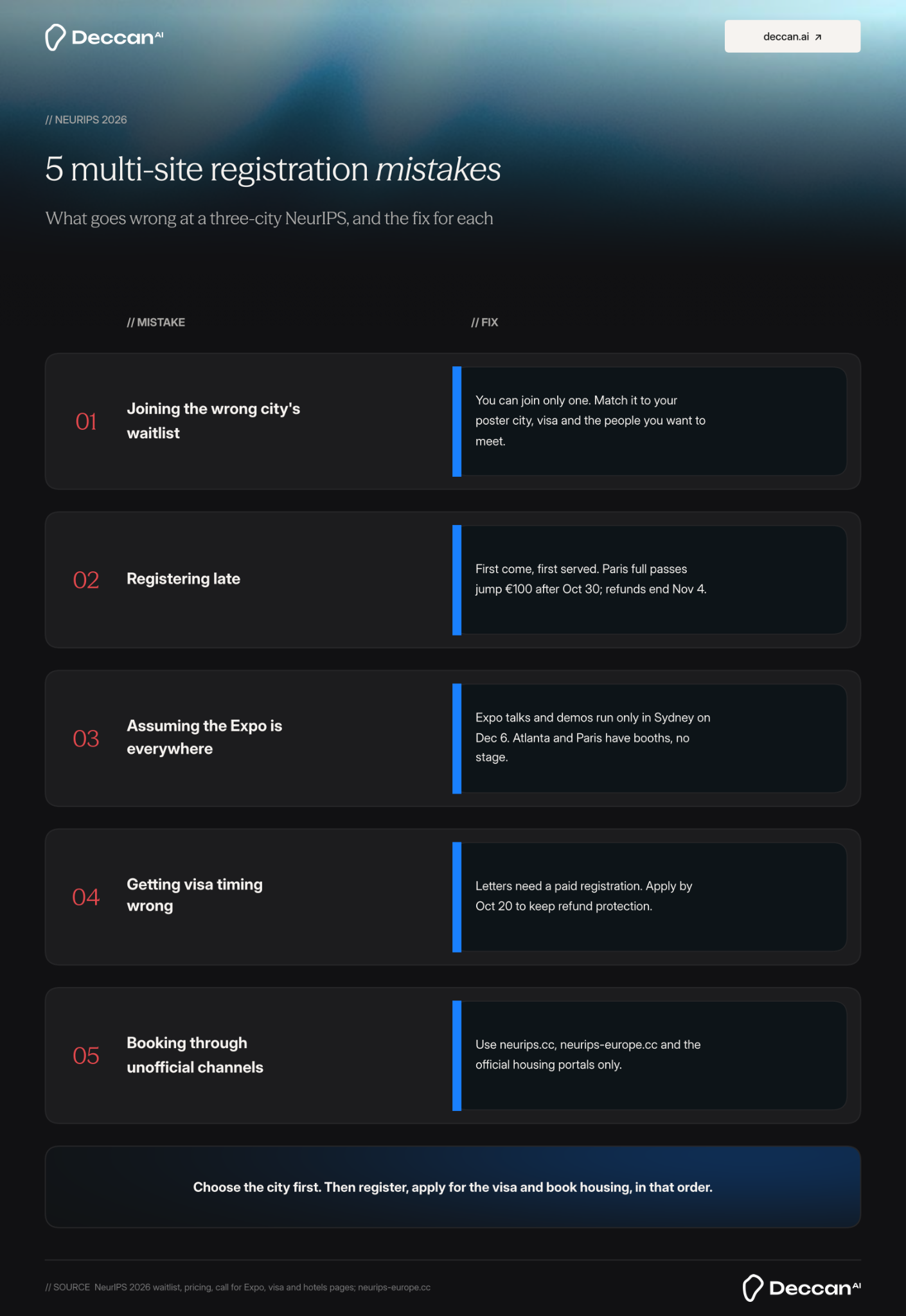
1. Joining the wrong city's waitlist
NeurIPS runs a separate waitlist for each location, and you can join only one. When extra seats open up, NeurIPS has said it will "exclusively rely on the waiting list to fill these additional spots." Waitlist order is randomized, with some weight given to when you joined. The waitlist page says tickets are expected to come back in two waves: mid-October, and again in late November once workshop presenters have registered.
The mistake is treating the waitlist as a formality and picking whichever city loads first. A co-author who joins the Sydney list when the team's poster was assigned to Paris may get a seat, just in the wrong country. A researcher who joins the Atlanta list but can't get a US visa interview in time has used their one waitlist slot on a trip they can't make.
The fix: Pick the city before you join. Match it to where your team's posters were assigned on October 6, to where your visa is realistic, and to where the people you want to meet will be. Then add @neurips.cc to your email safe-senders list, because offers come from do-not-reply@neurips.cc and NeurIPS asks people not to write in about their position.
2. Registering late and assuming you can fix it later
General registration is first come, first served. Every accepted paper in the core tracks gets exactly one guaranteed seat, for one designated presenting author, at one site. Once that seat is taken, the session shows as sold out to the paper's other authors, who then register as members of the public like everyone else.
Late registration costs money too. Paris shows the difference plainly: a full industrial pass costs 850 euros until October 30 and 950 euros from October 31, and a full student pass goes from 380 to 480 euros. Paris also holds seats for presenting authors only until October 30. For Sydney and Atlanta, the official dates page lists October 30 AoE as the early deadline.
Canceling to "re-book later" doesn't work either. Registrations canceled before November 4 AoE get a full refund, but if a site is sold out, a canceled ticket goes back into the reserve pool and you probably won't get it back. Registrations can't be transferred to a colleague.
The fix: Register the people you know are going this week, at the early rate, and treat November 4 as the last day to change your mind about anyone.
3. Assuming the Expo happens in every city
All three sites have an exhibit hall where sponsors run booths. Only Sydney has the Expo. The Expo is a single day, December 6, of sponsor talks, demos and workshops, and the NeurIPS call for Expo says it directly: "There are no expo talks/demos/workshops in Atlanta or Paris." Expo applications closed on October 9.
This trips up industry teams in two ways. A company that won an Expo slot and then registers its speakers in Atlanta because the flights are shorter has a talk scheduled on another continent. And a team that registers for Paris expecting to see the Expo demos will find booths but no Expo program. Lensmor's planning guide makes the same point: don't assume every workshop, expo activity or networking event is identical across the three sites.
The exhibit halls still matter outside Sydney. Lucy Vost's first-timer guide on the Oxford Protein Informatics Group blog notes that larger booths often run their own talk schedules that never appear in the main program, so "don't skip the expo hall" applies in Atlanta and Paris too.
The fix: If your company has an Expo slot, the speakers register for Sydney. If your team is going to see the Expo, Sydney is the only option. Everywhere else, check booth schedules early.
4. Getting the visa timing wrong
Every site needs a paid, in-person registration before NeurIPS will issue a visa invitation letter, and the three countries run on different clocks. NeurIPS asks Sydney travelers to apply at least 6 to 8 weeks before travel, which put the safe window in late October for a December 6 start. US applicants have an extra step: after submitting the DS-160, they must go back to the NeurIPS letter page and enter their US visa application number, and NeurIPS warns that interview wait times "can be highly variable." Paris letters are requested during registration on the Paris site, after full payment.
The date that catches people is October 20. After November 4, NeurIPS will convert a registration to virtual and refund the difference only if you applied for your visa by October 20 and it was then denied or went unanswered. Apply on October 21 and a late denial costs you the full fee. NeurIPS also stops generating visa letters once the conference closes.
Workshop authors are most exposed. NeurIPS tells them to apply before their workshop paper is accepted, because waiting makes it "very likely that you will not get your visa decision before the conference."
The fix: Register first, generate the letter the same day, and get the application in by October 20. Keep proof of the application date. Any denial request has to reach NeurIPS through its contact form by December 20.
5. Booking housing or registration through unofficial channels
On August 25, NeurIPS posted a notice that it has "no affiliation or partnership with any third-party service that claims to collect registration or housing information." Lensmor's guide gives the same advice: generate letters only through the official site and "avoid unofficial booking agencies."
The risk is familiar to anyone who has exhibited at a large conference. Unofficial housing companies, which the events industry calls housing pirates, email attendees and sponsors offering rooms "near the venue" at conference rates. Some are overpriced resellers. Some take a deposit and never book anything. Even legitimate bookings made outside the official block can backfire, since the Sydney and Atlanta hotel page says booking "directly with any hotel or third party" risks losing the group rate.
The official channels are short and easy to check:
- Sydney and Atlanta: the official NeurIPS Housing Portal run by Resiada, linked from neurips.cc/Conferences/2026/Hotels. Sponsors who need 10 or more rooms email Neuripshousing@resiada.com.
- Paris: Revolugo, which the Paris organizing team appointed as its official housing partner, also linked from the NeurIPS hotels page.
- Registration: neurips.cc for Sydney and Atlanta, neurips-europe.cc for Paris. Nowhere else.
The fix: If an email offers NeurIPS rooms or registration and didn't come from those addresses, delete it. Book everything from links you reached through neurips.cc yourself.
NeurIPS 2026 registration dates to keep
The pattern behind all five mistakes is the same. NeurIPS 2026 is three conferences sharing one paper list, and every registration decision now carries a city. Choose the city first, then register, apply for the visa and book housing in that order, all through official links.