NeurIPS 2026 runs in three cities in December, and every team that isn't sending a presenting author gets to choose one. Sydney is the main site (December 6 to 12). Atlanta and Paris are official satellites (December 9 to 13). Each has keynotes, orals, posters, tutorials, workshops,s and an exhibit hall. They are not copies of each other, though, and the differences matter more for industry teams than for academics.
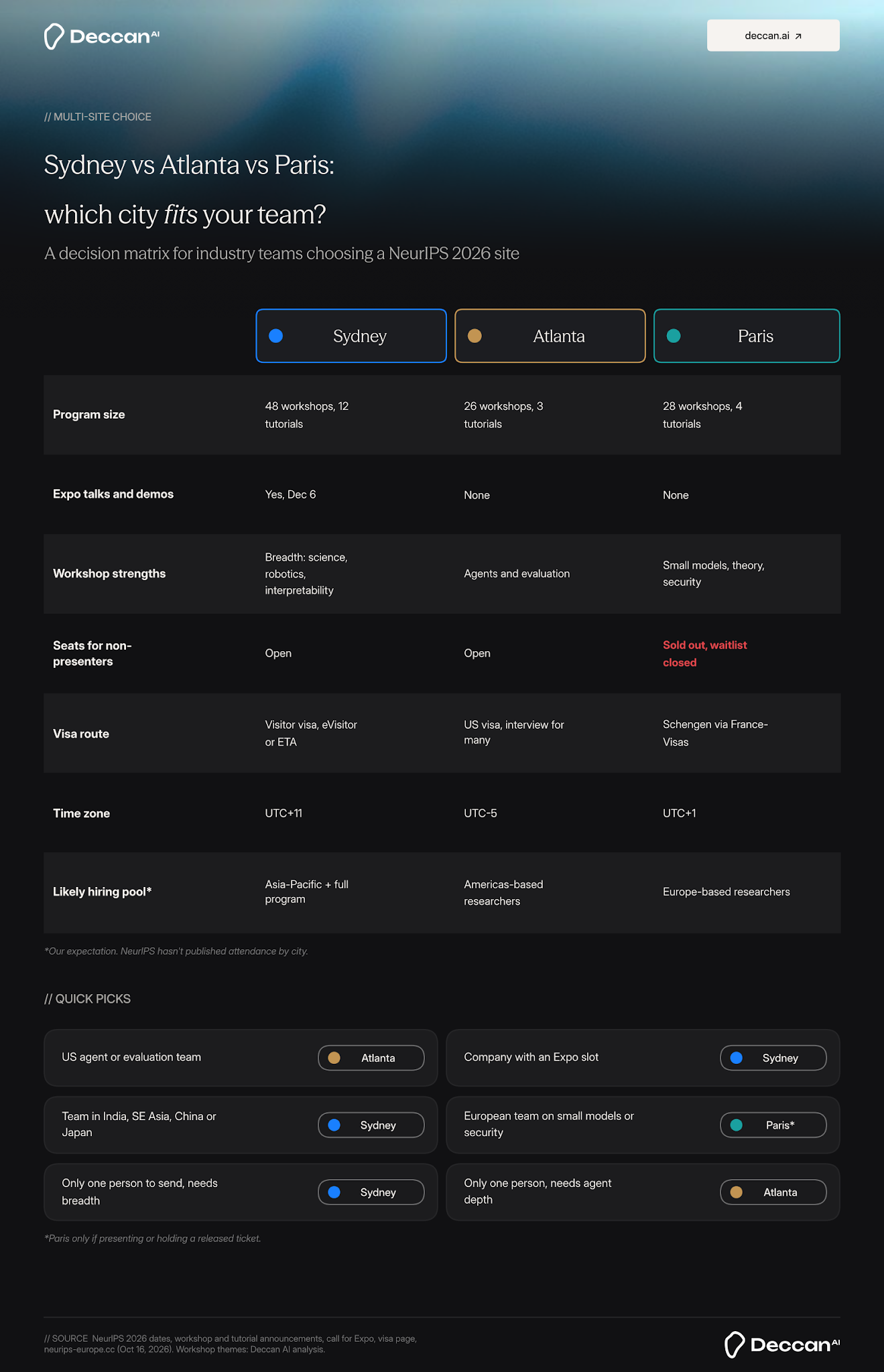
Most guides stop at dates and venues. This one goes through the seven factors that should actually decide the city for a company or lab, puts them in one matrix, and ends with a quick pick for common team types.
The decision matrix
The last row is our expectation, not data. NeurIPS hasn't published attendance by city.
1. How much of the program you need
Sydney is the full conference. It has 48 of the 102 workshops, 12 of the 19 tutorials, and the only Expo day. NeurIPS gave it the most because it is "the conference's main site, which has more capacity." It also runs longest: Expo on December 6, tutorials on December 7, main conference December 8 to 1,0 and workshops on December 11 and 12.
Atlanta and Paris run a compressed version. Each has three days of main conference (December 9 to 11) with tutorials inside them, then two workshop days on December 12 and 13. If your team wants to sample widely across research areas, Sydney gives you the most per trip. If you know exactly which four or five sessions matter, a satellite can cover them in less time.
2. Do you need the Expo?
This one is binary. The Expo, with its sponsor talks, demos,os and workshops, runs only in Sydney, on December 6. NeurIPS's call for Expo puts it plainly: "There are no expo talks/demos/workshops in Atlanta or Paris."
All three cities have exhibit halls with sponsor booths, so a company can still have a presence in Atlanta or Paris. What it can't have is a stage. If your company was accepted for an Expo slot, your speakers go to Sydney. If your team wants to watch what other companies present at the Expo, Sydney is also the only option.
3. Which workshops match your work
Workshops are where applied teams get the most value, and each city leans in a different direction. We grouped all 102 workshops by primary theme. The grouping is ours, but the pattern is clear.
Atlanta is the most concentrated on agents and evaluation. Eight of its 26 workshop titles mention agents, the highest share of any site, and it hosts both "Can We Trust the Judge?" on LLM evaluators and the Workshop on Evaluation of Interactive Agents, on back-to-back days. A product team building agents could spend both workshop days there without a wasted session.
Sydney has the broadest spread. It holds 7 of the 9 workshops we tagged under robotics and world models, 4 of the 5 on interpretability, and 13 on science and health applications. Its agent safety program is also strong: Agents in the Wild and Who Verifies the Agents? both run there, unfortunately on the same Friday.
Paris leans toward efficient models, theory,ory and security. Four of the six workshops we tagged under efficiency and small models are there, including SLM-Agents and LIGHT (deployable small foundation models), along with Foundations of Language Model Security and a workshop on user simulation for evaluation. Only 3 of its titles mention agents.
Pick the city whose workshop list reads like your roadmap.
4. Can you still get a seat?
This factor can make the decision for you. Paris registration for anyone who isn't a presenting author is sold out, and its waiting list is closed. The Paris organizers expect to release some tickets at the end of October, but there is no guarantee of a seat.
Sydney and Atlanta are still open, with no sold-out notice as of mid-October. Early rates end on October 30, and each city keeps its own waitlist, which you can join for only one site. If Paris is your first choice and you aren't presenting, have a backup city ready.
5. Visas and travel
Each site comes with a different entry process, and NeurIPS's visa page treats them separately.
- Sydney: depending on your passport, a Visitor visa (subclass 600, Business stream), an eVisitor, or an ETA. NeurIPS asks travelers to apply at least 6 to 8 weeks ahead, which means now for a December 6 start.
- Atlanta: many passport holders need a US visa with an in-person interview, and NeurIPS warns that wait times "can be highly variable." It also lists incomplete applications as a common reason for past denials.
- Paris: a Schengen visa for those who need one, applied for through France-Visas after you request a letter during Paris registration.
For every site, the visa letter requires a paid, in-person registration, and October 20 is the last day to apply for a visa if you want the option to convert to virtual and get a partial refund if it's denied later.
The practical rule for industry teams is to send people where they can reliably get in. A researcher who already holds a valid US visa is a safer bet for Atlanta than a stronger candidate still waiting for an interview slot. Teams in Europe can usually reach Paris with the least paperwork, and teams in Asia-Pacific face the shortest flights to Sydney.
6. Time zones and your home office
Your team doesn't stop working while three people are at NeurIPS. The city you pick decides whether the people at home can join calls, watch live sessions,s or get same-day notes.
A US team in Atlanta works on almost normal hours. A European team in Paris is on its own clock. Asian teams sit closest to Sydney, and for a team in Bangalore, Sydney's morning sessions land in the early hours, with afternoon sessions ending around midday at home. The worst pairings are the long ones: a San Francisco team following Sydney live, or an Asian team following Atlanta.
7. Who you want to meet and hire
NeurIPS has been a recruiting event for years. Fortune's 2023 coverage described big tech firms, funded startups, Wall Street trading firms, and Chinese tech companies all sending recruiters, with Semafor's Louise Matsakis calling it "the hottest event for recruiting AI talent." In 2026, that crowd is split three ways.
NeurIPS hasn't released attendance by city, so the best guide is where people can travel easily. Europe-based PhD students and postdocs now have Paris. The European satellite the year before, EurIPS in Copenhagen, drew about 2,200 people and sold out, which suggests strong demand. Researchers already in the US, including international students who'd rather not leave the country mid-program, have Atlanta. Sydney is likely to draw researchers from across Asia-Pacific, plus anyone who wants the full program.
So start from your hiring plan. Roles in London, Paris, Zurich, or Berlin point to Paris. US roles, especially where candidates need existing US work or study status, point to Atlanta. Teams hiring for Singapore, Bangalore, Tokyo or Sydney, or hiring broadly across research areas, get the most from Sydney. Whatever you choose, post roles on the NeurIPS career site, which takes applications until December 8 and covers all three cities.
Quick picks by team type
- US-based agent or evaluation product team: Atlanta. Agent-heavy workshops, two evaluation days in a row, and home-office hours.
- Company with an accepted Expo slot, or one that wants maximum sponsor visibility: Sydney. It's the only stage.
- Team based in India, Southeast Asia, China or Japan: Sydney. Closest time zone, full program,m and the broadest recruiting pool for the region.
- European team working on small models, efficiency, or LLM security: Paris, if your people are presenting authors or you can get a released ticket. Otherwise, Sydney for breadth or Atlanta for agents.
- Research lab with authors assigned to more than one city: follow the posters. Presenting authors are locked to their assigned site, so plan senior attendance around where most of your lab's work is being shown.
- Team that can send only one person: Sydney if they need range, Atlanta if they need depth on agents and evaluation.
Splitting the team
Larger companies don't have to pick only one. Splitting across two cities can work if each group has a clear job: Sydney for the Expo and broad scouting, Atlanta or Paris for depth in one area and regional hiring. What doesn't work is spreading three people across three cities with no plan, because nobody covers anything well. If you split, agree before you leave on how notes will be shared across time zones that can be 16 hours apart.
The bottom line
For most industry teams, the right city is the one where your target hires and your most relevant workshops overlap, and where your people can actually get visas and seats. Use the matrix, check the Paris situation first, and register before October 30.