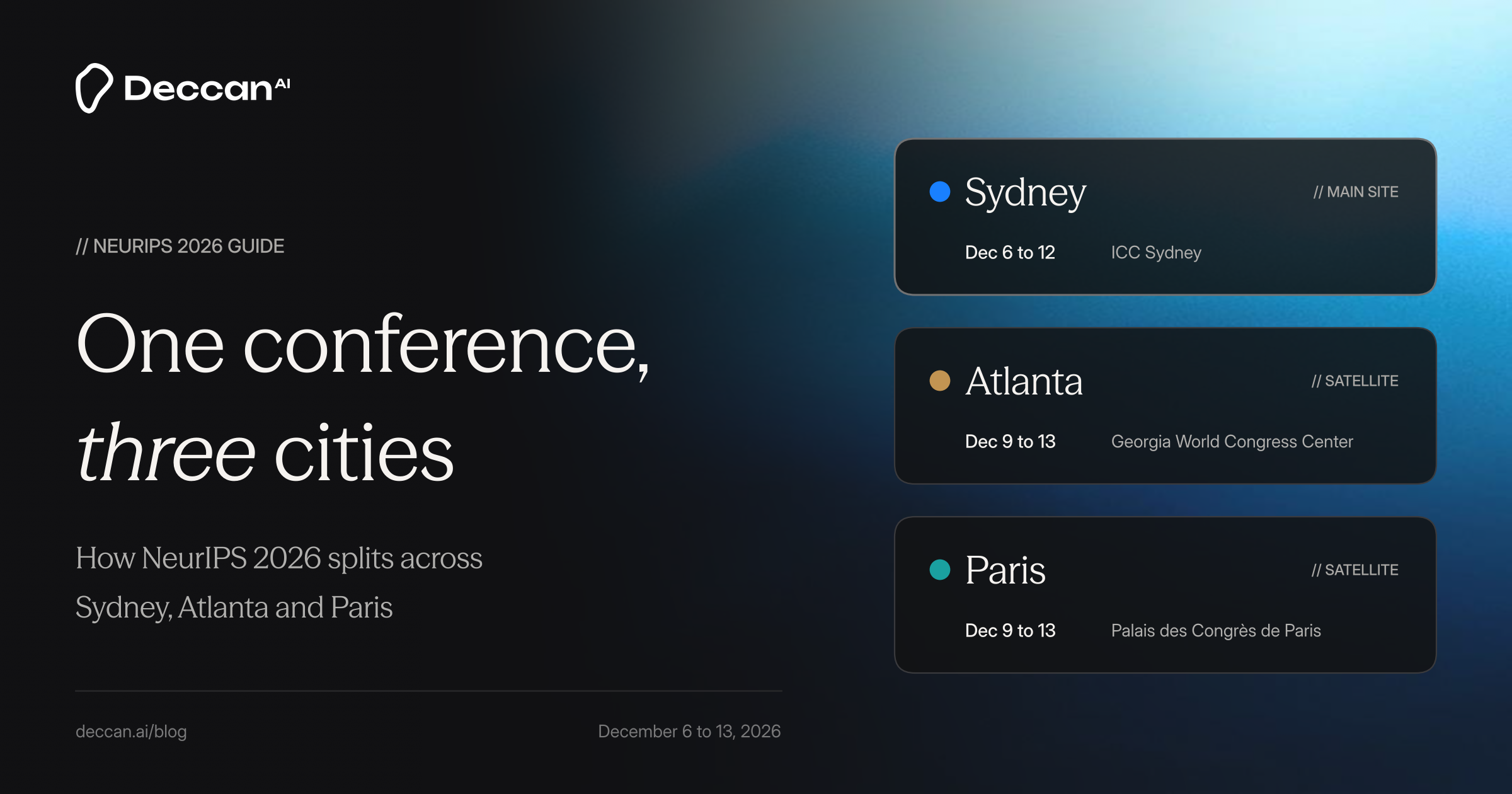
NeurIPS 2026 runs from December 6 to 13 in three cities at once. Sydney is the main site. Atlanta and Paris are official satellites, and each one has its own keynotes, oral and poster sessions, tutorials, workshops, and exhibit hall. Every accepted paper is presented in person at one of the three cities, not all of them.
For anyone who goes to NeurIPS to hire researchers, meet collaborators or show their lab's work, that changes the plan. The people you want to talk to are now spread across three continents and three time zones. No single trip reaches all of them.
This guide covers how the format works, where the three sites differ, how presenters ended up in each city, and what recruiting and research teams should do about it.
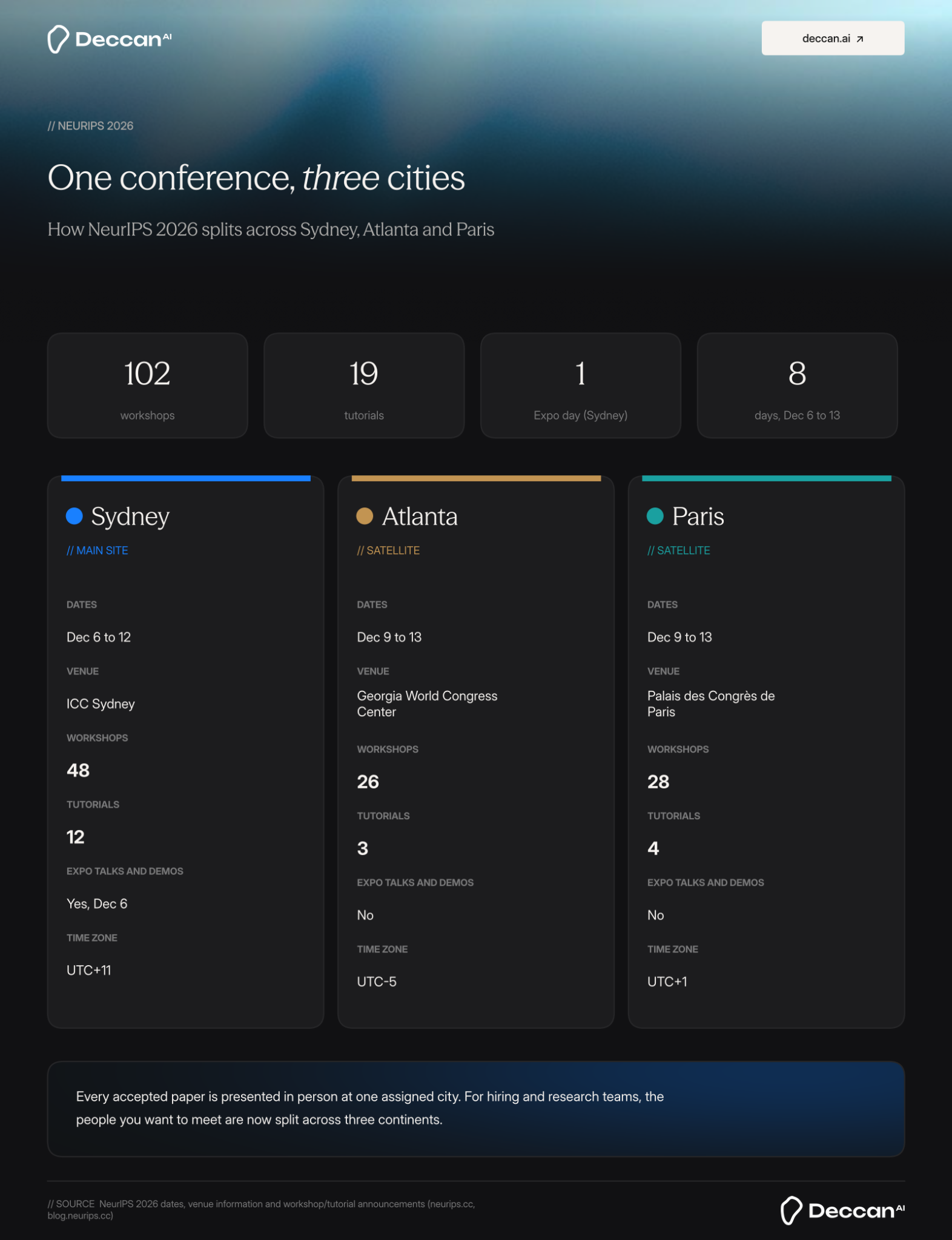
NeurIPS 2026 at a glance
Some early NeurIPS posts list Atlanta as December 8 to 13. Exhibitor move-in starts on December 8, but the official dates page now puts Atlanta's program on December 9 to 13.
Why NeurIPS split into three cities
The plain reason is size. NeurIPS received 9,467 main-track submissions in 2020 and 21,575 in 2025, according to the 2025 program chairs. Third-party trackers OpenAccept and csconfstats list 30,709 submissions and 7,900 accepted papers for 2026, a 25.7% acceptance rate. NeurIPS has not broken down its 2026 numbers on its own blog, so treat those as provisional. Either way, the curve only points one direction, and a convention center has a fixed number of poster boards.
The 2025 pilots also worked. Last year NeurIPS ran an official secondary site in Mexico City alongside the main event in San Diego. Separately, the ELLIS network organized EurIPS in Copenhagen, a community-run satellite where European authors could present their NeurIPS papers without flying to California. EurIPS drew about 2,200 people, sold out, and ran out of workshop space. Søren Hauberg, one of its organizers, said the team "thought we might manage four workshops." In an audience poll there, 20% said they came for European collaboration and 15% cited climate.
When NeurIPS announced the 2026 satellites, it pointed straight at those pilots. Paris is the follow-on to EurIPS, with ELLIS involved in choosing the European venue.
Travel friction is the third factor. NeurIPS's own visa guidance describes US visa interview waits as "highly variable" and says incomplete applications were a common reason for denials in previous years. In 2026 the conference also had to correct a sanctions-screening link in its author handbook that went further than its legal obligations, after researchers raised concerns about who could take part. More sites mean that no single country's entry rules decide who gets to present. NeurIPS states the aim as "fair access to participants worldwide."
The organizers call the three-site format an experiment. It is the first year NeurIPS has run with two official satellites.
The three sites are not identical copies
Sydney has the full program and most of the room. It is the only site with an Expo day (December 6) for sponsor talks, demos and workshops. The expo call is blunt about it: "There are no expo talks/demos/workshops in Atlanta or Paris." Sydney also received 12 of the 19 tutorials and 48 of the 102 workshops, because it is "the conference's main site, which has more capacity." The new Education track primer for science communicators runs there on December 7.
Atlanta and Paris run a shorter version. Each has three days of main conference from December 9 to 11, with tutorials inside those days, then two workshop days on December 12 and 13. Both have exhibit halls, so sponsors can still hold booths. Atlanta is chaired by Mark Riedl and Irfan Essa of Georgia Tech. Paris has a six-person chair team (Olivier Cappé, Laetitia Chapel, Rémi Flamary, Pierre Marion, Linus Bleistein and Edwige Cyffers) and a separate registration system at neurips-europe.cc.
Workshop acceptance rates differed by city: 21.5% in Sydney, 23.6% in Atlanta and 25.4% in Paris. NeurIPS puts the gap down to submission counts and room availability at each venue, not different quality bars.
Then there is the clock. In December, Sydney is 10 hours ahead of Paris and 16 hours ahead of Atlanta. When Sydney's last main-conference sessions wrap up on the evening of December 10, Paris is having breakfast and Atlanta is asleep. Anyone hoping to follow a second site live will be watching at odd hours.
How presenters were assigned to each city
This part matters most for anyone planning meetings, because it decides who is physically where.
Each accepted paper in the core tracks (Main, Evaluations and Datasets, Position Papers, Journal-to-Conference and Reproducibility) gets one guaranteed registration. That spot belongs to a single designated presenting author and is tied to a single site. Authors submitted site preferences before decisions, and NeurIPS says those preferences had "absolutely no impact" on acceptance. Authors could update them until September 30. Where a site filled up, posters were placed through a randomized process that weighed need and preference, so nobody was promised their first choice. Location assignments went out on October 6, and after that, no changes to the presenting author or poster site are allowed.
Co-authors who want to attend register as members of the public. General registration is first come, first served, and each city has its own waitlist. You can only join one. Workshop, competition, Creative AI, and Education contributions each get one reserved registration tied to their scheduled site.
So a paper's author list tells you who did the work. The poster assignment tells you where one of those people will be standing. The rest of the team may be in another city, or at home.
What this means for AI talent and recruiting teams
NeurIPS has long been where AI labs, big tech research groups, and startups find their next hires. Recruiting now takes a decision that used to be automatic: which city.
Pick the site by where your roles are
We expect attendees to sort themselves by geography. Europe-based PhD students and postdocs who skipped San Diego in 2025 now have Paris. Researchers already in the US, including international students on study visas who would rather not leave the country mid-program, have Atlanta. Sydney gets researchers from across Asia-Pacific, plus anyone who wants the full program and the Expo. That is our read of the incentives, not published data. NeurIPS has not released per-site attendance.
Start from the hiring plan, then. Roles based in London, Paris, Zurich, or Berlin point to Paris. US roles, especially where you want candidates who already have US work or study status, point to Atlanta. If you are hiring for teams in Singapore, Bangalore, Tokyo or Sydney, or if your recruiting pitch depends on giving a technical talk, Sydney is the only site where that talk can happen.
Build your target list from poster assignments
The accepted papers list is public, and so are poster locations once the program is final. The poster topics deadline is November 15, which is when session groupings settle. Filter for the research areas you hire in, note which authors are presenting at your chosen site, and plan your days around those poster sessions. Poster halls are still where most first conversations at NeurIPS start.
Use the career site for everyone else
The NeurIPS career site opened on September 1, takes applications until December 8, and closes on January 12, 2027. It is the one recruiting channel that covers all three cities. If you are only staffing one site, post roles there so candidates in the other two can still reach you.
Do one city well
A three-person recruiting team split across Sydney, Atlanta and Paris usually ends up as three thin presences. For most companies, one fully staffed site plus the career site beats a token booth everywhere. Large sponsors face a different trade-off, since only Sydney offers Expo talks and demos. Sponsor applications close in early November, so that choice has to be made well before the program is final.
What this means for research teams and labs
Plan travel around assignments, not preferences
The presenting author is locked to a site, so flights and hotels should follow the October assignment notice, not the preference form. NeurIPS has group hotel rates for all three cities on its official hotels page. It also warns that it has no affiliation with third-party services offering registration or housing, so book through neurips.cc or neurips-europe.cc only.
Start visas early, and expect three different processes
Each country runs its own system, and the NeurIPS visa page treats them separately:
- Australia: apply at least 6 to 8 weeks before travel. You must buy an in-person registration before you can generate the invitation letter. Depending on your passport, the route is a Visitor visa (subclass 600, Business stream), an eVisitor (651) or an ETA (601).
- United States: register, generate the letter, submit the DS-160, then go back to the letter page and enter your US visa application number. NeurIPS says skipping that last step "may impact your ability to enter the United States." Carry a printed letter at the border.
- France: request the invitation letter during registration on the Paris site, then apply through the France-Visas portal.
- Workshop authors: apply before your paper is accepted. NeurIPS warns that waiting for acceptance makes it "very likely that you will not get your visa decision before the conference."
Decide who goes where
A lab with several accepted papers may find its presenters split across two or three cities. Junior authors go where their poster is. Senior researchers and group leads can choose, and the useful question is where most of their students, collaborators and target hires will be, rather than which city has the bigger name. The early registration deadline is October 30, the last date for a registration refund is November 4, and childcare registration for Sydney and Atlanta closes on November 7.
Is the multi-site model here to stay?
Our view is yes, in some form. Submissions more than doubled between 2020 and 2025. San Diego already hosted roughly 24,500 in-person registrants in 2025, by IntuitionLabs' count. Before Paris was confirmed, the EurIPS organizers were planning for 3,000 to 3,500 people in 2026. Demand for a European NeurIPS clearly exists, and a single venue cannot keep absorbing growth of roughly 40% a year.
The costs are real too. A conference split three ways loses some of the chance meetings between a student from Nairobi and a lab head from Seattle that made NeurIPS useful in the first place. Sydney's program is also visibly richer than the satellites', which could push the most active researchers toward the main site and leave the satellites feeling secondary. The numbers to watch after December are per-site attendance and whether NeurIPS 2027 keeps two satellites, adds more or folds back to one venue.
For hiring and research planning, assume multi-site is the default from now on. Build next year's conference budget around choosing a city, not just booking one.
NeurIPS 2026 planning checklist
- Confirm which site each of your presenting authors was assigned (notices went out October 6).
- Register before the October 30 early deadline. Refunds end November 4.
- Start visa applications now if anyone is travelling to Sydney, since Australia asks for 6 to 8 weeks.
- For recruiting, pick one primary city based on where your open roles are.
- Pull the accepted papers list and filter by research area and poster site.
- Post open roles on the NeurIPS career site before it stops taking applications on December 8.
- Book hotels through the official NeurIPS hotel pages only.
- Agree in advance how the team will share notes across time zones if people are at different sites.
Frequently asked questions
When and where is NeurIPS 2026?
NeurIPS 2026 runs in Sydney, Australia from December 6 to 12 (main site, at ICC Sydney), in Atlanta, USA from December 9 to 13 (Georgia World Congress Center), and in Paris, France from December 9 to 13 (Palais des Congrès de Paris).
Is NeurIPS 2026 the same at all three sites?
No. All three have keynotes, orals, posters, tutorials, workshops, and an exhibit hall. Sydney has more of everything, including 12 of 19 tutorials and 48 of 102 workshops, and it is the only site with an Expo day for sponsor talks and demos.
Does one registration cover all three cities?
No. Registrations are tied to a site. Sydney and Atlanta register through neurips.cc, and Paris through neurips-europe.cc. Guaranteed author registrations are tied only to the site where the poster was assigned.
Can an author change their presentation city?
Not after allocations are final. NeurIPS says no changes to the presenting author or poster location are permitted once assignments are set. Authors who registered for the wrong site before assignment can cancel for a full refund up to November 4 and register again at the right one.
Where is the NeurIPS 2026 Expo?
Only in Sydney, on December 6. Atlanta and Paris have exhibit halls with sponsor booths but no expo talks, demos, or expo workshops.
Which NeurIPS 2026 site is best for recruiting AI researchers?
It depends on where your roles are. Paris is likely to draw Europe-based researchers, Atlanta researchers already based in the Americas, and Sydney researchers from Asia-Pacific, plus anyone who wants the full program. Pick the site that matches your hiring locations and use the NeurIPS career site to reach candidates in the other two.
Was NeurIPS 2025 also multi-site?
Partly. NeurIPS 2025 was held in San Diego with an official secondary site in Mexico City, and EurIPS ran in Copenhagen as a separate, community-organized satellite. NeurIPS 2026 is the first edition with two official satellites running alongside the main site.