September 29 was the deadline for NeurIPS 2026 workshops to send accept or reject decisions to authors. Most of the workshops on this list set their decision date for that exact day. Two weeks later, accepted-paper lists are going up on workshop sites, and the program for December is starting to take shape.
There is a lot to sort through. NeurIPS accepted 102 workshops out of 454 valid proposals: 48 in Sydney, 28 in Paris and 26 in Atlanta. Sydney's run on December 11 and 12. Paris and Atlanta hold theirs on December 12 and 13. For a team that builds products on top of language models, a large share of those days covers physics, biology, robotics and theory that won't change what you ship next quarter.
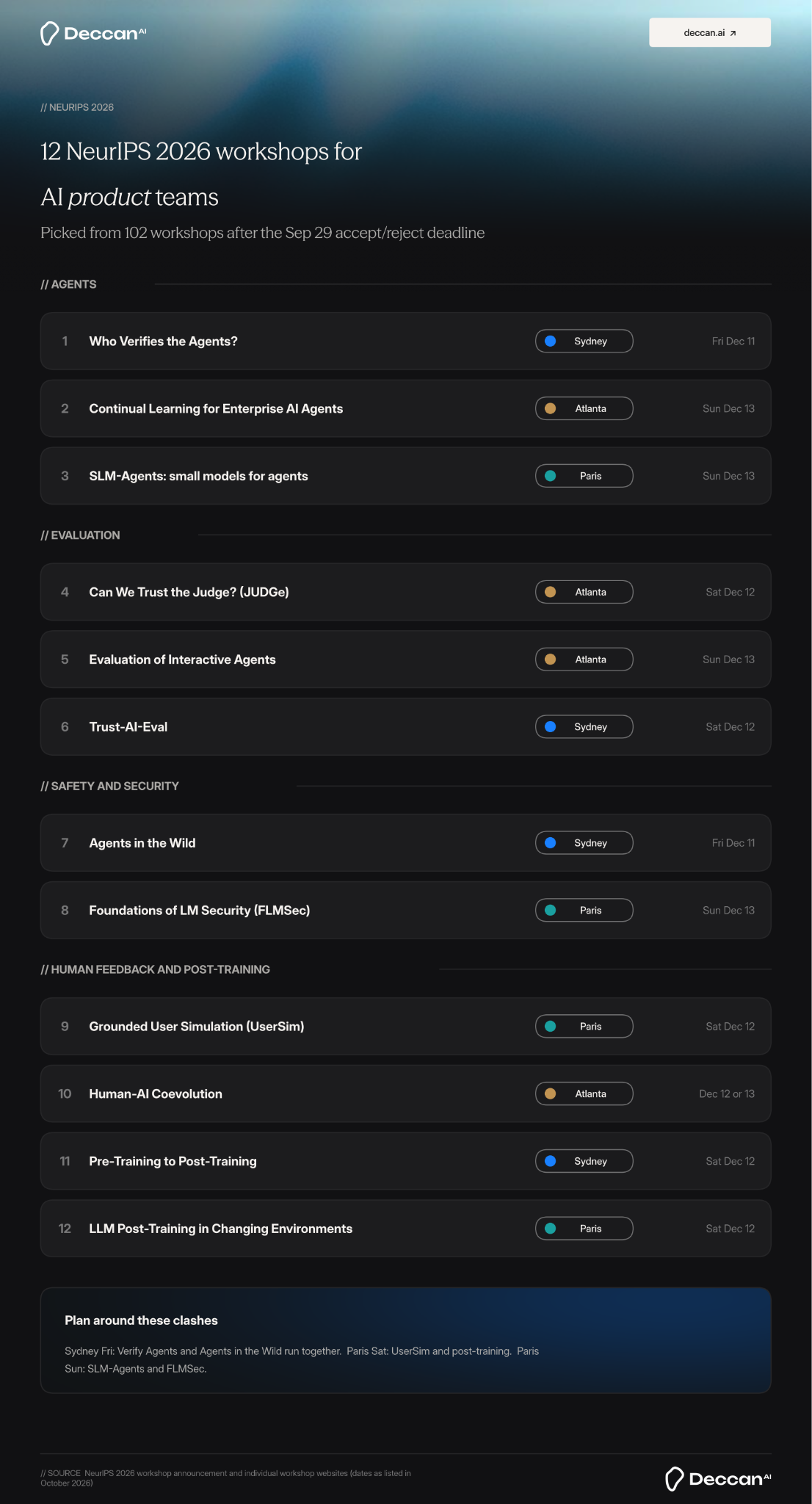
So we filtered the list down to four themes product teams deal with every week (agents, evaluation, safety and human feedback) and picked the 12 workshops in those areas most likely to change how you build. Each one is tagged with its city and date, because at a three-city NeurIPS that decides whether you can attend at all.
Why product teams should spend time on workshops
The main track is where polished, archival research lands. Workshops are where people bring the problem they are stuck on this month. Nearly every workshop on this list is non-archival, so authors can share early results without giving up a later conference submission, and industry labs use them to float work that isn't ready for a full paper.
Lucy Vost's first-timer guide on the Oxford Protein Informatics Group blog puts it simply: "Prioritise workshops." Her advice was to pick the workshops closest to your field and plan poster visits ahead, because wandering doesn't work at a conference of 17,000 people. For applied teams, that holds even more. A workshop on LLM judges will tell you more about your eval pipeline in one day than three days of main-track posters.
All 12 workshops at a glance
Agents
1. Who Verifies the Agents? Toward Reliable Agent Development
Sydney, Friday, December 11
The organizers call verification "the bottleneck between fragile prototypes and scalable, reliable agent systems," and the workshop treats it as a research field in its own right. The program covers verifiers, environment-grounded evaluation and simulators, and how to combine different verification signals. Speakers include Ion Stoica (UC Berkeley, Anyscale and Databricks), Azalia Mirhoseini (Stanford), Yu Su (Ohio State), Pin-Yu Chen (IBM) and Seshendra Nalla (Datadog).
Watch it if you have ever shipped an agent change, seen a metric go up, and not been sure the agent actually got better.
2. Continual Learning for Enterprise AI Agents (CLEA)
Atlanta, Sunday, December 13
CLEA looks at how agents keep improving after deployment: model adaptation, memory, orchestration and governance in enterprise settings. It already lists 40 accepted papers. Keynotes come from Bing Liu (University of Illinois Chicago), Rama Akkiraju (NVIDIA) and Azalia Mirhoseini, and the organizing team is mostly from IBM, with Michael Littman (Brown) and Chengxiang Zhai (UIUC) also on it.
This is the most enterprise-focused agent workshop at NeurIPS 2026. If your agents run inside customer workflows and drift over time, start here.
3. SLM-Agents: Small Language Models for Agentic Systems
Paris, Sunday, December 13
The argument here is that small models can handle many of the narrow, repetitive sub-tasks inside agent workflows, where large cloud models struggle on latency, privacy and cost. Topics include distillation, hardware co-design and training small models for tool use and planning. Speakers include Emmanuel Abbe (EPFL and Apple), Amin Karbasi (Cisco Foundation AI), Layla El Asri (RBC Borealis) and Emad Barsoum (AMD), with AMD, Huawei, Cerebras and BASF among the sponsors.
For teams whose agent bills are climbing, this is the cost and latency workshop.
Evaluation
4. Can We Trust the Judge? Building Reliable Evaluation for Language Models (JUDGe)
Atlanta, Saturday, December 12
JUDGe asks a question most product teams skip: "how do we know whether an LLM evaluator is actually measuring what we intend it to measure?" It covers judge bias, sycophancy and benchmark construction. The organizers are drafting a "Judge Deployment Disclosure Template," a model-card-style standard for evaluation pipelines, and plan to refine it with attendees. Eugene Yan (Anthropic) is listed as keynote, and the panel includes Jennifer Wortman Vaughan (Microsoft Research) and Vijai Mohan (Google DeepMind).
If LLM-as-judge scores decide what you ship, this is the most directly useful day on the list. Everything is in person only.
5. Workshop on Evaluation of Interactive Agents
Atlanta, Sunday, December 13
This one focuses on agents that hold multi-turn conversations, call tools and operate computers. Topics include validating user simulators, designing graders, trajectory-level metrics, and safety and privacy in evaluation. Confirmed speakers include Lianhui Qin (UC San Diego), Heinrich Peters (Apple), Tanmay Gupta (Hark) and Morteza Dehghani (USC).
It pairs well with JUDGe, so an Atlanta weekend gives you two evaluation days back to back.
6. Trust-AI-Eval (TAE): Can We Trust AI Evaluation?
Sydney, Saturday, December 12
TAE treats evaluation itself as the thing under study. Its sessions look at what a protocol actually measures, which assumptions link it to the claim being made, and when the evidence is strong enough to justify deployment. Speakers include Bin Yu (UC Berkeley), Soheil Feizi (University of Maryland), Liming Zhu (CSIRO and UNSW) and Julien Monteil (Amazon).
This is Sydney's main evaluation workshop, and the better fit for teams that need to defend eval results to regulators or enterprise buyers.
Safety and security
7. Agents in the Wild: Safety, Security, and Beyond
Sydney, Friday, December 11
In its third edition after workshops at ICLR and ICML in 2026, Agents in the Wild covers agent oversight, prompt injection and other security threats, multi-agent coordination and governance. The earlier editions drew 237 and 327 submissions. The speaker list is the strongest on this page: Yoshua Bengio, Dawn Song (UC Berkeley), Bo Li (UIUC and Meta Superintelligence Labs), Chen Liang (Google DeepMind), Kai-Wei Chang (UCLA), and two speakers from Scale AI, among others. It runs in Hall 5 at ICC Sydney.
It clashes with Who Verifies the Agents? on the same Friday in the same building, so Sydney teams interested in agents will need to split up or choose.
8. Foundations of Language Model Security (FLMSec)
Paris, Sunday, December 13
FLMSec wants to move LLM security past the cycle of new attack, new patch, toward systems that are secure by design. It asks whether the trade-off between security and usefulness is unavoidable. Talks include Christian Schroeder de Witt (Oxford) on fundamental limits of security and Reza Shokri (Google and NUS) on privacy in AI agents, plus demos from Lakera AI and Sondera. The format favors discussion: each block has a 45-minute keynote and a 30-minute small-group session.
Useful for security leads who are tired of patching prompt-injection bugs one at a time.
Human feedback and post-training
9. Grounded User Simulation for Model Evaluation and Training (UserSim)
Paris, Saturday, December 12
Simulated users now stand in for real people in a lot of agent evaluation and training. UserSim asks when that can be trusted, and its motivating finding is blunt: "measured agent success shifted by as much as nine points depending on which model played the user." Speakers include Craig Boutilier (Google Research) and Seraphina Goldfarb-Tarrant (Cohere). The organizers plan a baseline simulator, reporting guidance and a benchmark catalog, and the day will be livestreamed and recorded.
If your eval suite uses an LLM to play the customer, this workshop is about you.
10. Human-AI Coevolution: Measuring Human-Agent Teams in the Agentic Era (HAIC)
Atlanta, December 12 or 13 (one day, schedule to be confirmed)
HAIC studies how agents and the people using them change each other over time. Its three themes are validity in real deployments, what happens to human feedback when experts disagree, and adaptive testing that tracks drift. Case studies come from healthcare, aviation and finance. The site cites a review finding that "83% of evaluations are dominated by technical metrics," which is the gap this workshop is trying to close. Speakers include Matthew Gombolay (Georgia Tech) and Liwei Jiang (NVIDIA).
Product teams running human-in-the-loop review will find the most practical discussion of feedback quality here.
11. Transitioning from Pre-Training to Post-Training
Sydney, Saturday, December 12
This first-edition workshop asks what a base model needs to provide for post-training to work, and whether signals during pre-training can predict where post-training will fail. Its stated aim is to "turn folklore about this pipeline into science." The speaker list is heavy on people who shaped current post-training practice: Sergey Levine (UC Berkeley), Hanna Hajishirzi (University of Washington), Sewon Min (UC Berkeley and AI2), Jason Weston (Meta FAIR) and Akshay Krishnamurthy (Microsoft Research). It will be livestreamed and recorded.
For teams choosing which base model to fine-tune, this is the most relevant workshop in Sydney.
12. Foundations of LLM Post-Training in Changing Environments
Paris, Saturday, December 12
Most fine-tuning advice assumes a fixed task. This workshop starts from the opposite case, where tasks, data, feedback and evaluation standards keep shifting after deployment, and looks for theory that explains when repeated adaptation causes regressions. Speakers include Mihaela van der Schaar, Yee Whye Teh, Yali Du, Giorgia Ramponi and Gido van de Ven, with ELLIS Oxford and ELLIS Paris among the partners.
It speaks to any team that retrains on fresh user feedback every few weeks and keeps breaking things that used to work.
Clashes to plan around
Three pairs on this list share a day and a city. In Sydney, Who Verifies the Agents? and Agents in the Wild both run on Friday, December 11. In Paris, UserSim and the post-training workshop share Saturday, December 12, and SLM-Agents and FLMSec share Sunday, December 13. Atlanta is easier: JUDGe on Saturday and the interactive agents workshop on Sunday make a clean two-day evaluation track, with CLEA competing for Sunday.
If you can only send one person to one city, Atlanta covers evaluation best, Sydney covers agents and safety best, and Paris covers small models, security and user simulation.
Also on the radar, by city
- Sydney: First Workshop on Meta Agents; AgenticOS; Agentic AI Benchmark and Application for Enterprise Tasks; Dynamic Alignment in Human-AI Coupled Systems; Interpreting Agent Behavior; Beyond Private Training.
- Atlanta: Workshop on Resource-Aware Agentic AI; The Agentic Web; Towards Test-Time Continual Learning Agents; AI for Verifiable Coding; Workshop on Child Safety in AI.
- Paris: Foundations of Agentic Systems Theory; PALM (personalized, aligned, long-term memory); LIGHT (deployable small foundation models); Privacy in the Era of Large Opaque Models.
Calls that are still open
Workshop paper decisions are done, but a few competition tracks attached to the workshop program were still taking entries in mid-October, according to AI Workshop Tracker. The Predictive AI Evaluation Competition (Sydney) closes on October 31. The AI for Verifiable Coding competition track (Atlanta) closes on November 9. Check each workshop's own site before you rely on a date.
How to follow if you are not going
Most of these workshops are non-archival, so accepted papers appear on their sites and on OpenReview rather than in proceedings. UserSim and the pre-training to post-training workshop have both said they will livestream and record. For the rest, the NeurIPS virtual-only pass covers the conference's live streams. A Paris Saturday in UserSim starts around 7 PM in Sydney and 3 AM in Atlanta, so plan to catch up on recordings rather than watching live from another continent.